Date: December 8, 2025
To: Members of the Ethics Commission
From: Olabisi Matthews, Director of Enforcement
Re: AGENDA ITEM 5: Quarterly Enforcement Report
Summary and Action Requested
This report provides general programmatic updates and data about the cases handled by the Commission’s Enforcement Division.
No action is required by the Commission, as this item is for informational purposes only.
Cases Resolved
Summary data is provided below regarding cases handled by the Commission’s Enforcement Division to assist the Commission and the public in understanding and following the Commission’s administration of its enforcement powers granted under the San Francisco Charter.
Fiscal Year 2026
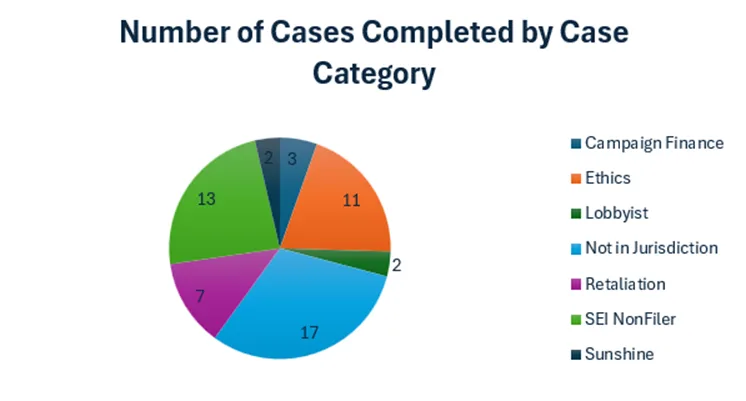
So far in Fiscal Year 2026 (July 1, 2025 – November 30, 2025), the Enforcement Division has completed a total of 55 enforcement cases summarized in Chart 1 below:
Chart 1 – Number of Cases Completed by Case Category: 55
Cases In Progress
So far in FY26, 65 enforcement matters have been initiated. 35 of these cases were initiated through complaints that the Commission received from the public. 23 of the 65 cases are cases that the Division initiated based on media reports, observations in public disclosures, independent research, findings from audit reports, or interactions with regulated persons. Six matters were initiated based on referrals from the Controller’s Whistleblower Program. One of the matters was initiated based on a referral from the Sunshine Task Force. Some of these matters initiated in FY26 remain in progress while others have already been resolved.
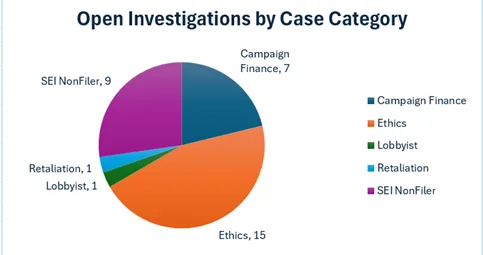
In total, 41 matters are currently in progress, including one matter initiated during FY24 and 19 initiated in FY25. Of these matters, 8 are in preliminary review, and 33 are open investigations. The matter initiated in FY24 (In the Matter of Charlie Chiem) is currently before the Commission for discussion and action on preliminary matters and will be ready to proceed to a Hearing on the Merits once the Commission decides on how to proceed. One of the matters initiated in FY25 (In the Matter of Sophia Andary) is currently before the Commission for consideration and ratification of the proposed Stipulation.
The current cases in progress are broken down by program area in charts 2 and 3 below.
Chart 2 – Matters in Preliminary Review by Program Area: 8
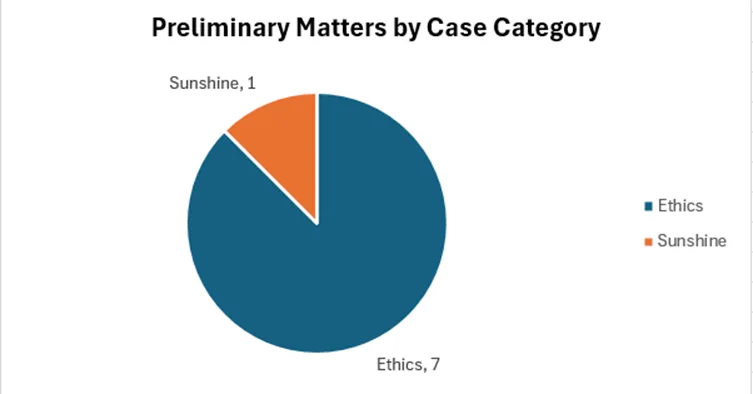
Chart 3 – Open Investigations by Program Area: 33
Enforcement Regulation Review
The Enforcement Division is conducting a comprehensive review of its Enforcement Regulations to identify gaps, clarify ambiguities, and strengthen provisions that guide the enforcement process. The goal of this effort is to ensure that the regulations more effectively inform the Commission, respondents, staff, and the public about the rules governing enforcement, and to support a process that is transparent, efficient, and fair. Enforcement Staff have previously presented recommended amendments to the Commission and have incorporated the valuable feedback received at those meetings into the ongoing revisions. The updated recommendations are not presented at this meeting because we are still engaged in the required meet-and-confer process with the Municipal Executives Association (“MEA”). Once that process concludes, Enforcement Staff will return to the Commission to seek approval of the finalized proposed amendments.
Staff continue to welcome feedback and questions from the Commission as revisions progress.
Statement of Economic Interests (“Form 700”) and Certification of Completion of the Annual Ethics and Sunshine Trainings – Enforcement Cases
The universal electronic filing of the Form 700 on January 1, 2022, which requires all Form 700 filers to file their disclosures electronically through the Commission’s NetFile system, has allowed Commission Staff to track compliance in real time and to identify which of the City’s 5,958 filers have failed to file the Form 700 or have done so late. At this time, 5,879 filers (98.7%) have filed a Form 700 that was due in April 2025. Of these, 337 (5.7%) filed late. Currently, out of 5,958 filers who were required to file an Annual Form 700 in 2025, there are 79 filers (1.3%) who failed to file that Annual Form 700. This is on par with 2024 in which 78 filers (1.4%) failed to file their Annual Form 700 at this time.
Of note, prior to initiation of any enforcement matters this year, the Enforcement Division adopted a new “pre-enforcement grace period” for late filers by sending out a pre-enforcement (or one final post-filing deadline) notice in August to 414 filers whom NetFile identified as out of compliance with filing of their Form 700 or certifying completion of their annual Ethics Training or Sunshine Ordinance Training. The purpose of this grace period was to give filers additional opportunity to come into compliance to avoid any fines or penalties once the Enforcement Division initiated investigations against non-filers. Following these notices, 103 filers fulfilled their filing requirement for a Form 700 due in 2025 and 78 filers fulfilled their Annual Ethics Training and Sunshine Ordinance Training requirements for 2025. The Enforcement Division then used an objective set of criteria to select 21 filers of the remaining 234 filers who had failed to fulfill their filing requirements by the end of the grace period and initiated enforcement matters against those filers. The selection criteria used include the filer’s disclosure category, position (with decision-makers being prioritized), history of non-filing, department (with departments with higher rates of non-compliance being prioritized), and whether the filer had also failed to file certify completion of their Ethics or Sunshine Ordinance Trainings that were due in 2025. Because of the staffing resources required to review each non-filer and investigate each case, the Division sets a target of 20 non-filers cases to review annually. This year, the Division reviewed 21 out of 234 non-filers (9%). Of the 21 cases initiated, 12 have been resolved via warning letter, while the rest are still under investigation. Each case is administered through the Streamlined Administrative Resolution Program (“SARP”) unless evidence indicates that the case is ineligible for SARP. This could happen if large financial interests were required to be disclosed on the missing Form 700 or if a conflict of interest or incompatible activity is discovered.
The Enforcement Division and the Engagement and Compliance Division collaborated on the effort to identify non-filers and to provide guidance to allow non-filers come into compliance. Both Divisions will continue to coordinate closely on all aspects of the annual filing process, including communications to filers. This collaboration will help ensure that all filers receive clear and timely notice of their filing obligations and the consequences of noncompliance—including disqualification from participating in any agenda items before a City officer’s board or commission. The divisions will also work together to promptly identify non-filers for any necessary enforcement action.