December 8, 2025
To: Members of the Ethics Commission
From: Eamonn Wilson, Audit Manager
Subject: Agenda Item 6 – Audits Division Update
Summary and Action Requested
This report provides general programmatic updates about the Ethics Commission’s Audits Division (the “Division”). No action is required by the Commission, as this item is for informational purposes only.
Staffing Update
The Division completed the recruitment for its vacant Auditor II (1684) position. Meah Chinn began work on October 28, 2025. Meah most recently worked at Grant Thornton as a Senior Audit Associate where she audited financial statements to ensure accuracy and compliance with accounting guidance and performed testing of controls. Meah has a Bachelor of Arts in Accounting and Business Administration from MidAmerica Nazarene University and a Master of Accountancy from Lindenwood University. Meah is also a licensed Certified Public Accountant (CPA).
2024 Priority Audits
Audit Cycle Overview
San Francisco Charter Section C3.699-11 authorizes the Commission to audit the campaign statements of campaign committees that file with the Commission. San Francisco Campaign and Governmental Conduct Code (“C&GCC”) Section 1.150(a) requires the Commission to audit all committees of candidates who have received public financing and authorizes the Commission to initiate targeted audits of other committees at its discretion.
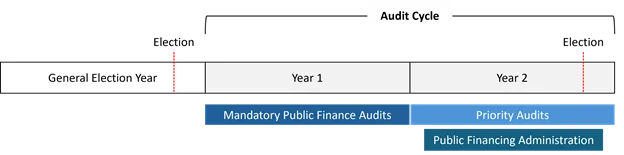
As noted in previous reports, the Division aims to complete all audits associated with a general election by the end of the calendar year of the following election. This is intended to prevent the compounding of active audits across election years. Accordingly, the term “audit cycle” as used by Division staff refers to the two-year period following a general election.
As illustrated in Chart 1 below, the Division will prioritize the completion of all mandatory Public Finance Audits in Year 1 of the audit cycle. In Year 2, the Division will conduct additional audits of other types of committees. Because Year 2 will be a general election year, the Division will simultaneously be responsible for administering the Public Financing Program for that year’s election and will have the capacity to audit fewer committees associated with the prior election.
The Division therefore has the resources to audit only the highest priority committees. Accordingly, the Division refers to those audits conducted during the second year of an audit cycle as its “Priority Audits.”
Chart 1. Example Audit Cycle
It is vital that the Division conducts audits beyond only those required by Section 1.150(a) because publicly financed candidate committees represent only a fraction of total campaign spending and the total number of committees filing with the Commission, as shown in Chart 2 below.
Chart 2. Publicly financed committees as a portion of total committees and total reported spending in 2023 to 2024
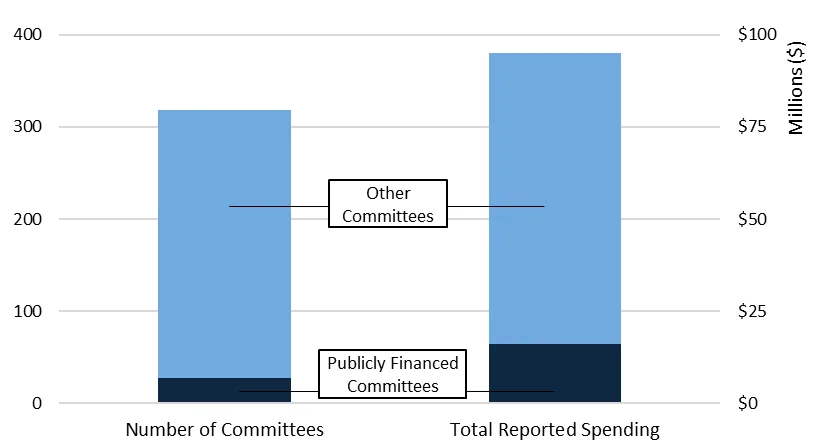
The above chart is based on data extracted from campaign statements electronically filed with the Commission covering campaign finance information disclosed for the reporting period beginning January 1, 2023, and ending December 31, 2024. Based on the Commission’s data, a total of 318 committees reported making expenditures totaling $95.1 million in 2023 and 2024. The 27 Mandatory Public Financing Audit Committees represent only 8.5% of all committees filing with the Commission and their total reported spending amounts to only 17% of total reported spending.
Priority Audit Committees
The Division has selected an initial tranche of six Priority Audit committees to be audited at the beginning of calendar year 2026. The Division’s selection of these committees was primarily based on total reported spending, as auditing the highest-spending committees is the most efficient way to assess the greatest share of campaign finance activity by performing the fewest audits. Staff also considered factors such as the quantity and variety of contributors and vendors and the portion of expenditures supporting or opposing other committees. Staff also prioritized selecting a variety of committee types (namely candidate committees, general purpose committees, and primarily formed committees), and committees represented by treasurers with whom the audit team has not yet worked as part of the mandatory Public Finance Audits.
The six committees included in the initial tranche of Priority Audits are listed below. These six committees reported total spending in 2023 and 2024 of $36.6 million, amounting to 38% of total reported spending by committees filing with the Commission during that period.
| Daniel Lurie for Mayor 2024 (ID # 1463099) |
| Committee to Fix San Francisco Government, Yes on D, No on E, A Coalition of San Francisco Civic Organizations Dedicated to Improving the City’s Future (ID # 1464767) |
| Believe in SF, Lurie for Mayor 2024 (ID # 1463554) |
| Neighbors For A Better San Francisco Advocacy (ID # 1431167) |
| Forward Action SF, Supporting London Breed for Mayor 2024, Sponsored by Abundance Network (ID # 1463715) |
| Mayor Mark Farrell for Yes on Prop D (ID # 1467847) |
The Division has notified the treasurers of these six committees that they have been selected for audit. Staff will formally initiate the audit process and request audit records around January 2026 after the holidays and after audit work for the 2024 mandatory Public Finance Audits has been completed.
During the first several months of 2026, the Division will monitor its ability to simultaneously conduct these six Priority Audits while administering the Public Financing Program. The Division intends to select additional Priority Audits of lower-spending committees based on risk assessments of filing data and other available information. The number of audits selected for subsequent tranches will be determined based on the Division’s ability to complete the initial six audits while balancing the workload of administering Public Financing.