The Commission’s proposed budget maintains essential functions within its $7.04 million baseline operating budget for FY27 and requests $7.41 million for FY28, reflecting a $18k increase above the $7.59 million baseline budget for FY28.
The Honorable Daniel Lurie, Mayor
City Hall, Room 200
1 Dr. Carlton B. Goodlett Place
San Francisco, CA 94102
Re: Ethics Commission FY27-FY28 Budget Submission
Dear Mayor Lurie:
Attached for your review and consideration is the Ethics Commission’s budget proposal for FY27 and FY28.
The Ethics Commission was established by San Francisco voters to serve as an independent oversight body that promotes accountability, transparency, and fairness in City government. By administering and enforcing conflict-of-interest, ethics, and lobbying laws, the Commission helps ensure that public resources are used for the benefit of San Francisco’s communities—not for personal gain. Similarly, the campaign finance laws enforced by the Commission ensure that expenditures in City elections are publicly disclosed and do not improperly influence the decision-making of elected officials. The Commission’s work fosters public trust, reinforcing the City’s ability to address critical issues, attract businesses and visitors, and advance key priorities such as economic recovery and public safety.
All these key objectives will be more difficult to achieve if the public does not trust City government to act with integrity to solve the problems facing our great City. In recent years, federal and local corruption investigations have led to multiple indictments and convictions against City officers, employees, and contractors for bribery, fraud, self-dealing, and pay-to-play schemes. These scandals have severely eroded public confidence in San Francisco’s government and damaged our reputation across the country. Without effective and sustained measures to prevent future corruption and restore trust, the City will face greater challenges in addressing its most pressing issues.
The Commission’s key objectives for the next two fiscal years include:
- Providing effective educational resources and compliance advice to better inform regulated communities about the law.
- Conducting thorough and timely audits.
- Conducting effective and timely investigations and enforcement actions.
- Ensuring robust electronic disclosure systems to promote filer compliance and provide public access to disclosure filings.
- Evaluating, strengthening, and refining the City’s ethics, campaign finance, lobbying, and other laws under the Commission’s jurisdiction.
- Carrying out operations using standardized procedures, performance indicators, automation, and data-driven approaches.
- Maintaining adequate staffing levels to support the Commission’s essential functions.
The Commission’s proposed operating budget maintains essential functions while cutting its general fund support to $6.81 million in FY27 and $7.41 million in FY28. Separately, the Commission’s proposed budget requests no change to the baseline budget for programmatic projects, including the Election Campaign Fund. Detailed budget justifications are provided in Sections I–III below.
The Commission has not identified a 10 percent budget reduction, as requested in this year’s budget instructions, because such a reduction would fundamentally impair our ability to meet voter-mandated responsibilities. With 86 percent of the Commission’s budget dedicated to personnel, cuts of this magnitude cannot be achieved without eliminating critical jobs and severely compromising core functions. This would diminish our capacity to enforce ethics and campaign finance laws, hold individuals accountable for violations, and provide transparency to the public—outcomes that are essential to maintaining integrity and public trust in City government. The specific impacts of reductions are detailed in Section IV below, and additional information on the Commission’s mission, structure, and functional divisions is included in Attachment A.
Thank you for your consideration of the Ethics Commission’s budget proposal. We look forward to discussing how the Commission’s priorities align with your vision for accountable and ethical government and revitalizing San Francisco.
Sincerely,
Patrick Ford
Executive Director
San Francisco Ethics Commission
I. Ethics Commission FY27-FY28 Departmental Budget Proposal – Operating Budget
| Position Requests | FY27 | FY28 |
| Fill Vacancy 1823 Compliance Counsel 1052 IS Analyst | – – | – – |
| Position Add-back Request 1823 Senior Program Administrator | $170,924 | $231,556 |
| Reallocate Position to Election Campaign Fund 1684 Auditor II (1 position at 0.5 FTE) | $(108,829) | $(117,220) |
| Total | $62,095 | $114,336 |
| Other Requests | FY27 | FY28 |
| Services of Other Departments | ||
| City Administrator’s Office (work order for payroll services) | $459 | $4,450 |
| Department of Human Resources (reduce existing work order) | $(140,345) | $(140,345) |
| Sub Total | $(139,886) | $(135,895) |
| Non-Personnel Services | ||
| Software Licenses (support departmental operations including website) | $3,500 | $4,000 |
| Sub Total | $3,500 | $4,000 |
| Total | $(136,386) | $(131,895) |
| BASELINE OPERATING BUDGET | $7,041,123 | $7,586,263 |
| REVENUE SUPPORT | $157,200 | $157,200 |
| BASELINE GENERAL FUND SUPPORT | $6,883,923 | $7,429,063 |
| PROPOSED GENERAL FUND SUPPORT | $6,809,632 | $7,411,504 |
| TOTAL PROPOSED CHANGE | $(74,291) | $(17,559) |
| PERCENTAGE PROPOSED CHANGE | (1.08)% | (0.24)% |
II. Ethics Commission FY27-FY28 Detailed Budget Proposal
POSITION RELATED REQUESTS
The Commission’s budget proposal seeks to retain essential staffing and add-back a key position in critical program areas beginning in FY27, as detailed below.
ENABLE CRITICAL COMPLIANCE FUNCTIONS
The Engagement and Compliance Division is responsible for administering the Commission’s compliance functions. This Division consists of four positions, with one vacancy, as outlined in the organization chart in Section III. This budget proposal seeks to fill the existing vacancy and add-back a position within the Division to better align with evolving programmatic needs, as detailed below.
- Fill 1823 Compliance Counsel position and restore the 1823 Senior Program Administrator position
ETH is requesting permission to fill one vacant 1823 Senior Program Administrator position and restore a second 1823 Senior Program Administrator to its Engagement and Compliance Division.
The existing vacancy arose in January 2026 when the Commission’s Compliance Counsel was promoted to Engagement & Compliance Manager. The second 1823 position became vacant at the end of January 2025 due to normal attrition, and was later removed during the FY26 budget cycle. These public-facing roles are essential for providing compliance guidance, filing assistance, training, technical support, and daily administration for all programs under the Ethics Commission’s jurisdiction.
The Commission has requested but not yet received approval to fill the vacant 1823 Senior Program Administrator position. The Commission also proposes restoring the second 1823 Senior Program Administrator position in the Engagement & Compliance Division. In response to losing this position last year, the Ethics Commission pursued several pieces of legislation that would sunset Commission programs, including the Major Developer, Trustee Election, and Campaign Consultant programs, and would streamline the administration of the public financing program. These changes would right-size the department’s work to account for the loss of the 1823 position. Unfortunately, this legislation has stalled at the Board of Supervisors and there is no indication that it will move forward. As a result, the Commission is left without the resources to carry out its charter and statutorily mandated functions. This proposal seeks to restore funding for the position to ensure that the Commission can continue providing critical compliance support.
The two 1823 positions will be responsible for carrying out essential compliance functions, including:
- Providing guidance and advice to regulated stakeholders—including City officials, political committees, and lobbyists—to enhance compliance with the Commission’s laws.
- Developing and delivering high-quality training tools, including in-person workshops, live webinars, and online training modules tailored to varied audiences.
- Creating compliance resources and maintaining up-to-date, accurate information on the Commission’s website.
- Assisting with the implementation and roll-out of newly adopted laws, policies, and business processes.
- Ensuring the completeness and accuracy of public disclosure filings.
- Tracking program performance measures, including compliance data and operational metrics, to ensure program effectiveness.
The Engagement and Compliance Division administers a wide range of compliance programs, including campaign finance, governmental ethics, conflicts of interest, lobbying, campaign consultants, permit consultants, and major developers. Without funding for these two positions, the Division’s compliance capacity will be reduced by half from what it was one year ago, significantly impairing the Commission’s ability to provide timely compliance guidance and assistance to filers and the public.
To fund the restoration of the 1823 Senior Program Administrator position that was eliminated in the FY26 budget, the Commission recommends funding this position through small workorders between all other City departments and the Ethics Commission. The Commission provides significant direct support to all City departments through advice, guidance, filer support, and training. Six-thousand City officers and employees file the Form 700, and all officials are required to comply with state and local ethics rules. This requires extensive support services provided by the Ethics Commission to other City departments. Currently, departments do not pay for these services that are provided by the Ethics Commission. If these compliance positions are not restored and/or filled, City employees and officials will lose access to this support. As such, it is appropriate to set up work orders to allow for continued compliance support to other City departments.
MAINTAIN STRONG SYSTEMS IN SUPPORT OF PUBLIC INFORMATION, COMPLIANCE, AND ENFORCEMENT
The Electronic Disclosure and Data Analysis (EDDA) Division oversees the Commission’s electronic filing systems, website, data analysis, open datasets, and public access systems. It is also responsible for technology procurement, contracting, and general IT services and support for the department. This Division consists of six positions: 1054 Director of Technology Services, 1053 Senior IS Analyst, 1052 IS Analyst, 1043 Senior IS Engineer, 1844 Senior Management Assistant, and 1840 Client Support Specialist. This budget proposal requests filling the 1052 IS Analyst position that was vacated in December 2025, to continue supporting the Commission’s effective use of technology to achieve enforcement and audit priorities. The Commission has previously requested but not received approval to fill this vacancy.
- Fill 1052 IS Analyst position
The continued vacancy of the 1052 IS Analyst position has created significant operational challenges and strategic risks for the Commission. Core responsibilities—such as maintaining the public website, ensuring accessibility compliance, supporting electronic filing systems, and developing automated workflows—have shifted to senior technical staff, diverting them from high-value projects and strategic planning. As a result, critical initiatives have stalled, including automation of audit and enforcement canvasses, modernization of case management systems, and development of campaign finance dashboards, especially for the 2026 election cycle. Compliance efforts tied to upcoming DOJ accessibility requirements are delayed, and reliance on manual workflows persists, reducing efficiency and responsiveness to new regulatory needs.
The vacancy also has long-term cost and risk implications. Senior staff are performing routine development and support work at a higher cost, while opportunities to reduce workload and operating expenses through automation are deferred. The Commission’s ability to improve accessibility, usability, and data transparency is constrained, and key projects—such as campaign finance dashboards—are now dependent on a single systems engineer, creating succession and continuity risks. Filling the 1052 IS Analyst position is essential to restore operational capacity, accelerate automation, and align with the City’s strategic goals for digital service delivery and efficiency. Leaving the role unfilled does not eliminate the work; it simply shifts it to higher-cost resources, delays critical projects, and increases operational risk.
Key responsibilities of the 1052 IS Analyst include:
- Developing and supporting the Commission’s public website and online services, including ongoing accessibility compliance, remediation, and content updates.
- Developing and maintaining the Commission’s case management system that supports enforcement intake, tracking, and reporting.
- Administering and maintaining the Commission’s online support portal system used by City officials, filers, regulated entities, and the public.
- Designing, building, and maintaining automated business processes across divisions to reduce manual work and increase efficiency.
- Developing, maintaining, and providing technical support for the Commission’s electronic filing systems, including both in-house and vendor-hosted systems.
- Providing technical support for the Commission’s hybrid public meetings.
MAINTAINING ELECTION OVERSIGHT
- Reallocating 0.5 FTE from 1684 Auditor II position
The Ethics Commission proposes to reallocate .5 FTE (Auditor II) from the Commission’s operating budget to the Election Campaign Fund (ECF), consistent with San Francisco Campaign and Governmental Conduct Code section 1.138. This fund was established to support the administration of the City’s Public Financing Program, including by funding personnel who support the program. This shift will relieve pressure on the Commission’s operating budget while ensuring continued audit capacity.
The Commission is not requesting a corresponding increase in funds placed into the ECF above the baseline. The Commission will use existing funds to cover these costs, thus leading to pure savings of the equivalent to .5 FTE of an Auditor II.
Finally, the Commission is requesting no change to the baseline allocation to its Election Campaign Fund.
SERVICES OF OTHER DEPARTMENTS Total in FY27: $(139,886) FY28: $(135,895)
The Commission’s FY27-FY28 budget proposal requests funding for the following services of other departments.
- Adjust funding for a continued work order with the City Administrator’s Office to assume payroll functions, enabling our department to transition payroll responsibilities. The amounts reflect the increase from the $49,734 baseline. FY27: $459 FY28: $4,450
- Reduce work order-related costs with the Department of Human Resources by 50 percent, leveraging internal staff capacity and anticipating fewer classification and recruitment actions to align spending with actual service needs while preserving funding for core compliance and enforcement programs. FY27: $(140,345) FY28: $(140,345)
NON-PERSONNEL SERVICES Total in FY27: $3,500 FY28: $4,000
The Commission’s FY27-FY28 budget proposal requests funding for the following non-personnel services.
- Funding for increases in software licenses used by staff to perform core business functions and essential technology to enable critical departmental operations, including software services to maintain the Commission’s website. FY27: $3,500 FY28: $4,000
ELECTION CAMPAIGN FUND
This Fund is established in the City’s Campaign Finance Reform Ordinance (CFRO) to provide partial public financing for candidates for Mayor and the Board of Supervisors who meet the required eligibility criteria. This is a separate fund which is not a part of the Commission’s operating budget. The Fund currently has a balance of $2 million and is capped at a maximum of $7 million. The City’s baseline budget for this fund currently assumes allocations of $2,974,897 for FY27 and $2,730,000 for FY28.
III. Organization Charts
Ethics Commission – Current Organization Chart (FY26)
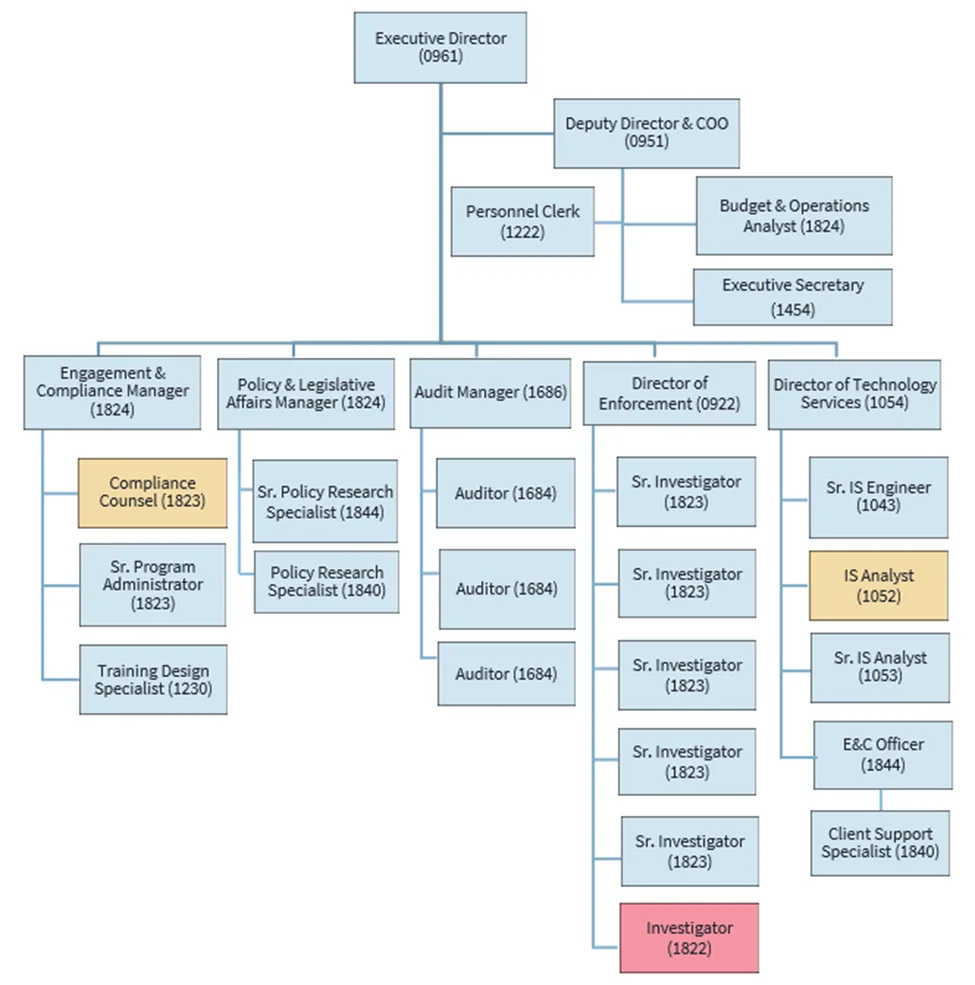
| 26 positions are currently filled |

Ethics Commission – FY27-FY28 Proposed Organization Chart
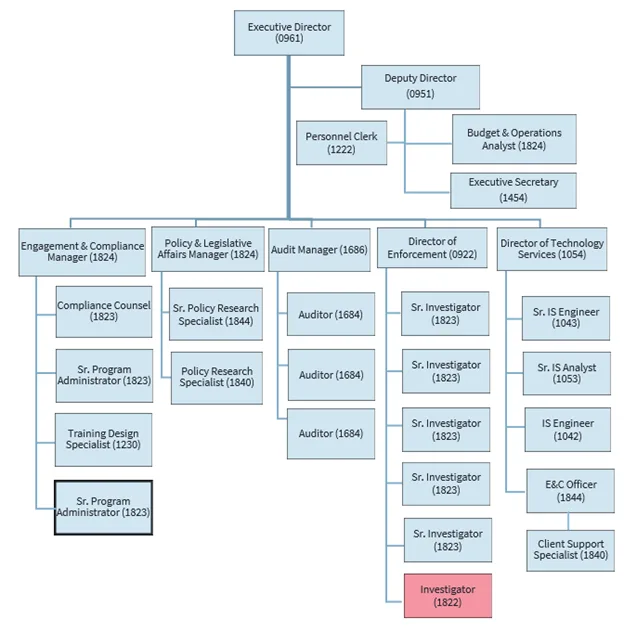
| 26 positions are currently filled. 30 positions will be funded under this scenario |
IV. Mayor’s Target Cuts
On December 12, 2025, the Mayor issued annual budget instructions to City departments for FY27 and FY28, along with a Programming Worksheet to be completed and submitted by all departments prior to directing the Ethics Commission to propose ongoing General Fund reductions of 10 percent to address the City’s $936.6 million two-year deficit. For the Ethics Commission, this represents an ongoing reduction of approximately $700,000 in FY27 and FY28.
As a small department, with approximately 86 percent of its budget allocated to salaries and benefits, a 10% cut would result in significant reductions to core services and operations, including substantial reductions in compliance assistance, decreased enforcement capacity, and risks to the Commission’s disclosure systems relied upon by regulated persons and the public.
Projected Operational Impacts
- Investigations and Enforcement
- Current staffing supports approximately 78 active investigations (mid-year). A staff reduction would likely cut this capacity, leaving serious ethics and campaign finance violations unaddressed.
- Fewer attorneys and investigators would mean delays of 6–12 months in resolving cases, reducing accountability and deterrence.
- Audits and Compliance Reviews
- The Commission currently conducts mandatory audits of all publicly financed campaigns and reviews thousands of disclosure filings. Cuts would force us to eliminate or drastically reduce audits, undermining election integrity and transparency.
- The Commission recently overhauled its audit program, eliminated its backlog, and completed 27 candidate audits in 13 months. The Commission would no longer be able to timely complete mandatory audits under the mandated cuts.
- Advice and Public Guidance
- Commission staff support over 2,000 requests for advice, guidance, and technical assistance annually from candidates, officials, City employees, and lobbyists. Staffing reduction would result in weeks-long delays in providing guidance, increasing the risk of inadvertent violations.
- Public Transparency
- Steep cuts would threaten the maintenance of real-time filing systems and disclosure tools, including the City’s Campaign Finance Dashboards, reducing public access to critical ethics and campaign finance data.
These reductions would fundamentally impair our ability to meet voter-mandated responsibilities under the City Charter, eroding the integrity of City government and weakening public trust—precisely the values voters sought to protect when they established the Commission.
ATTACHMENT A:
About The Ethics Commission
The San Francisco Ethics Commission was created directly by the City’s voters with the passage of Proposition K in November 1993. The Commission is composed of five members, with one each appointed by the Mayor, the Board of Supervisors, City Attorney, District Attorney and the Assessor-Recorder. The Commission’s mission is to practice and promote the highest standards of integrity in government by delivering impactful programs that promote fair, transparent, and accountable governmental decision making for the benefit of all San Franciscans.
Through its staff, the Commission is responsible for the independent and impartial administration and enforcement of laws related to campaign finance, governmental ethics, conflicts of interests, and registration and public disclosure reporting by lobbyists, campaign consultants, permit consultants, and major developers. The Commission acts as filing officer for over 80 different types of public disclosure statements; audits statements for compliance with state and local laws; investigates complaints alleging ethics and political reform law violations; raises public awareness of these laws; researches and proposes legislative changes; and provides guidance and advice about the applicability of the City’s political reform laws to City candidates, officers, employees and the general public. The Commission also administers a Public Campaign Financing Program which provides partial public financing for qualified candidates for Mayor and the Board of Supervisors.
Functional Divisions
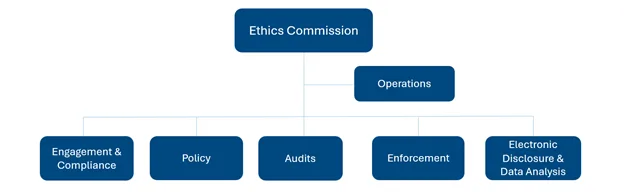
Engagement and Compliance: The Engagement and Compliance Division provides information and guidance to city officers and employees, candidates for public office, the public, and others to help them understand and comply with their responsibilities under the law. This division provides trainings, publishes compliance materials, and provides informal advice that applies the City’s ethics, campaign finance, and lobbying laws to circumstances faced in practice. The Commission also acts as filing officer for a wide range of public disclosure statements filed by designated local officials, candidates seeking local office, and lobbyists who seek to influence governmental decisions in the City and County of San Francisco.
Policy: This Division leads the Commission’s public policy research, analysis, and legislative work. It is responsible for analyzing how well current laws and programs are achieving their intended purposes and formulating new regulatory and legislative approaches to ensure the City’s political reform laws are strong, workable, and enforceable. Related duties assigned to the Division include media relations, interpreting and advising on the law, and stakeholder outreach and engagement. The Division also administers the Commission’s opinion and waiver programs.
Audits: The Audit Division is responsible for conducting campaign audits pursuant to the Commission’s Charter authority and mandate under City law to determine whether committees have materially complied with applicable requirements of State and local laws. The Division also administers the Public Campaign Financing Program qualification and claim review process to determine candidate eligibility and public funds disbursements. In addition, the Audit Division is responsible for conducting audits required under City law related to the lobbyist registration.
Enforcement: To fulfill the Ethics Commission’s oversight mandate as an independent administrative enforcement agency, the Enforcement Division is charged with ensuring fair, thorough, and timely investigations and case outcomes that serve as an effective deterrent and promote accountability in government. The Division has responsibility to identify, investigate, and remedy unlawful conduct within the scope of the Commission’s jurisdiction. The Division’s investigators are responsible for investigating alleged violations of the law to ensure allegations are fully and objectively evaluated and that those who violate the law are held publicly accountable for their actions. This can include imposition of monetary penalties levied by the five-member Ethics Commission as provided for under the law.
Electronic Disclosure and Data Analysis (EDDA): This Division serves filers, Commission staff, and the public by providing integrated and effective technology solutions for compliance, agency operations, and access to electronic disclosure records and data. The EDDA Division develops integrated technology solutions to support the Commission’s various programs. The Division maintains the electronic disclosure platforms for campaign finance, lobbyist, Form 700, and other filings. The Division also ensures that the public has complete and timely access to the disclosures, such as through the campaign finance data dashboards and the City’s open data portal.
Operations: This Division is responsible for leading department-wide initiatives and operations, including budget development, financial accounting, procurement, contracting, performance reporting, payroll, human resources, recruitment, office management, and other administrative functions. The Division also supports the Commission’s front-office functions as the first point of contact for the public and assists with facilitating the Commission’s public meetings. The Division also helps establish and implement office policies and standard operating procedures to strengthen departmental business processes.