Summary and Action Requested
This report provides findings and recommendations regarding the City’s campaign finance rules. The report identifies shortcomings in the City’s current laws which have been observed in recent years and makes recommendations to strengthen existing rules and promote accountability for those who violate the rules.
In brief, the report makes the following recommendations:
- Apply the City’s candidate contribution limit to other types of candidate-controlled committees whenever those committees are controlled by a candidate actively running for City elective office.
- Specify that if a third party spends money to republish a candidate’s campaign materials, that spending should be considered a contribution to that candidate and be subject to the City’s candidate contribution limit.
- Establish limits on City elective officers using committee funds to pay penalties issued for violations of the Campaign and Governmental Conduct Code (C&GCC).
Draft legislation that would enact these recommendations is provided as Attachment 1 and corresponding draft regulations to help clarify and implement these recommendations are in Attachment 2.
This item is informational and requires no action by the Commission. The Commission should consider and offer feedback on the recommendations and draft language, so that Staff may incorporate that feedback into finalized legislative and regulation language for the Commission to potentially vote on during a future meeting.
Background
The Policy Division initiated work on this project to address issues identified in recent years, particularly during the 2024 election cycle. This report focuses primarily on shortcomings in current City law that undermine the City’s candidate contribution limit. These gaps in the current rules have been underscored in recent enforcement matters and identified through compliance questions posed to the Commission. The recommendations in this report seek to address these shortcomings by reinforcing and expanding the City’s existing candidate contribution limit.
The recommendations also aim to ensure that when City elective officers are found to have violated ethics or campaign finance-related rules, they cannot avoid existing gift rules and accountability by shifting their penalty burdens to committee contributors.
Staff held two Interested Persons meetings as part of this project, one on March 3rd and the other on March 6th, to gather perspectives, guide research, and identify potential improvements to the law.[1] During these meetings, Staff heard from 12 participants, representing the regulated community, various good government groups, and other jurisdictions.[2] Staff have also had direct communications with good government groups, the regulated community, and representatives from other jurisdictions outside of the Interested Persons meetings to understand best practices and inform the development of this report’s recommendations.[3]
The following sections explain the current rules, provide findings based on research, and make policy recommendations for the Commission to consider.
1. Candidates for City Elective Office Controlling Additional Committees Not Subject to the Candidate Contribution Limit
State and local campaign finance laws impose specific limits on the amount of money that can be contributed to candidates for elective office as a safeguard against corruption and undue influence. San Francisco has a contribution limit for all City elective offices that is $500 per election.[4] Candidate contribution limits exist to prevent quid pro quo corruption and undue influence over elected officials through large campaign contributions. Candidate contribution limits are foundational campaign finance rules. They exist almost universally throughout the United States and across California.[5] Such contribution limits have been upheld as constitutional because of the strong interest in preventing the corrupting influence of large campaign contributions.[6]
Any person or combination of persons will qualify as a “committee” if they receive contributions totaling $2,000 or more in a calendar year, and all committees maintain their active status from the date of qualification until whatever date they terminate.[7] The compliance requirements outlined by law vary depending on the type of committee and its level of financial activity. The type of committee is defined by its stated purpose and relationship to one or more candidates or measures.
A “candidate” includes anyone who is listed on the ballot or is qualified to have write-in votes cast on their behalf. The term also includes anyone who receives a political contribution, makes a political expenditure, or gives their consent for another person to receive a contribution or make an expenditure supporting their election. “Candidate” also includes any sitting elected officer, even if they are not currently running for reelection or for another elective office.[8] When seeking office, a candidate or officeholder must establish one controlled committee for the purpose of election to that office, with its own bank account. All contributions received must be deposited into, and all campaign expenditures must be made from, that campaign bank account.[9]
A “candidate-controlled committee” is any committee that is controlled directly or indirectly by a candidate. Candidates are deemed to control a committee directly if they have significant influence on the actions or decisions of the committee or otherwise act jointly with the committee in connection with the making of expenditures. A candidate controls a committee indirectly whenever an agent of the candidate or another committee controlled by the candidate has significant influence on the actions or decisions of the committee.[10] There are multiple types of “candidate-controlled committees” that a candidate or officeholder may control. Candidates often control multiple committees simultaneously.
The types of “candidate-controlled committees” include:
Candidate Committee: a committee controlled by a candidate to support their election to City elective office.[11] Candidate committees for City elective office are subject to a $500 contribution limit.[12] These committees and accounts may then be used by successful candidates (officeholders) to cover expenses related to holding that office.[13]
Candidate Committee for County Central Committee: a committee controlled by a candidate to support their election to county central committee (CCC) seats, which are considered state positions. Candidate committees for CCC elections are not subject to any contribution limit.[14]
Candidate-controlled Ballot Measure Committee: a committee controlled by a candidate that is primarily formed to support or oppose one or more ballot measures within the same election. Candidate-controlled ballot measure committees are not currently subject to any contribution limit.
Candidate-controlled General Purpose Committee: a committee controlled by a candidate to support or oppose a variety of measures, typically across multiple elections.[15] These committees are not currently subject to any contribution limits. However, City elective officers are prohibited under City law from controlling general purpose committees while in office. However, a candidate who is not yet an officeholder could still control a general purpose committee.[16]
Legal Defense Fund: a committee controlled by a candidate to pay for attorney fees and costs related to civil, criminal, or administrative proceedings directly related to an election campaign, the electoral process, or the performance of their governmental duties.[17] Legal defense funds are not currently subject to any contribution limit.
Under current law, a candidate for City elective office could control any of these other types of committees which are not subject to the City’s candidate contribution limit. For example, a candidate could be actively running for City elective office with a candidate committee subject to the $500 contribution limit, while simultaneously controlling a ballot measure committee which would not be subject to any contribution limits.
Findings
The ability of candidates to simultaneously run for City elective office while also controlling committees that are not subject to contribution limits can effectively bypass the City’s candidate contribution limit. This creates the danger of quid pro quo corruption and undue influence that the candidate contribution limit exists to prevent.
It Is Not Uncommon for Candidates to Control Multiple Committees
Candidates regularly control multiple committees within an election cycle, most often due to running for both a CCC seat and City elective office. The table below contains data from the last decade of completed election cycles. The table provides the number of candidates for City elective office and instances of when they controlled additional committees while running for office. More detailed information regarding these committees is also provided in Attachment 3.
Table 1: Candidates for City Elective Office Controlling Multiple Committees[18]
| Election Year | Number of City Candidates with a Candidate Committee | Number of Additional Committees Controlled by Candidates per Election Cycle | |||
| County Central Committee Committees | Ballot Measure Committees | Legal Defense Funds | All Committee Types | ||
| 2024 | 73 | 14 | 5 | 2 | 21 |
| 2022 | 40 | 0 | 0 | 2 | 2 |
| 2020 | 37 | 10 | 1 | 0 | 11 |
| 2019 | 23 | 0 | 0 | 1 | 1 |
| 2018 | 72 | 0 | 0 | 0 | 0 |
| 2016 | 43 | 19 | 0 | 0 | 19 |
| Totals: | 288 | 43 | 6 | 5 | 54 |
The trends around candidates controlling multiple committees appear linked primarily to election years in which there are open seats on the county central committees of qualified political parties. Of the 54 instances of candidates with multiple controlled committees, 43 of them included a candidate committee for the Democratic County Central Committee or the Republican County Central Committee. The remaining instances were comprised of six candidates with one or more ballot measure committees—all but one of which occurred during the 2024 election cycle—and five instances of active officeholders with legal defense funds.
Candidates Controlling Ballot Measure Committees Is on the Rise
During the 2024 election cycle, there were five separate candidates who controlled at least one ballot measure committee in addition to their candidate committee—all while simultaneously campaigning for City elective office. Between 2016-2024, there has been only one other instance of a candidate-controlled ballot measure committee in San Francisco.[19]
The sudden onset of candidate-controlled ballot measure committees, and how widespread they were within a single election cycle, raises concerns. Candidates may wish to control ballot measure committees while running for City elective office simply because they support the substance of the measure and wish to run a campaign to see it approved. However, candidates may also seek to use their ballot measure committees as a secondary vehicle to support their candidacy with funds raised by a committee not subject to the City’s contribution limits. Regardless of motivation, controlling a campaign committee that is not subject to contribution limits, while simultaneously running for City elective office, creates the danger of corruption through the circumvention of contribution limits.
Issues With Candidates Controlling Additional Committees While Running for City Office
Since the City’s $500 candidate contribution limit currently applies only to candidate committees, it is possible for candidates to open separate committees that can receive unlimited contributions for other purposes, such as promoting a ballot measure, which greatly exceed the contribution limit. These separate committees can then directly share expenses with the candidate’s other committee or make expenditures that are nominally for another purpose but still feature and potentially benefit the candidate.
A clear demonstration of these issues arose in a recent Ethics Commission enforcement matter that addressed fundraising disparities and shared expenses between the “Mayor Mark Farrell for Yes on Prop D” committee and the “Mark Farrell for Mayor 2024” committee.[20] The activity of these two committees was found to violate City law when the candidate-controlled ballot measure committee contributed, and the candidate committee for City office accepted, a significant amount of paid staff time and other valuable shared expenses that were improperly reimbursed between the two committees.
On the fundraising side, the Mayor Mark Farrell for Yes on Prop D ballot measure committee raised approximately $2.5 million during the calendar year 2024. In contrast, the Mark Farrell for Mayor 2024 candidate committee raised approximately $981,000 and received an additional $1.2 million in public financing (the maximum amount for non-incumbent candidates) during the same period. The ballot measure committee had approximately 88 contributions and the candidate committee had approximately 2,145 contributions, highlighting the difference between controlled committees that are and are not subject to the $500 candidate contribution limit. In particular, “six separate contributors had each contributed over $100,000 to the ballot measure committee (totaling just under $1.5 million, or 65% of the ballot measure committee’s total funds raised).”[21] Four of those six contributors also made $500 max contributions to the candidate committee.[22] The presence of a few well-financed contributors giving maximum contributions to a candidate’s committee for City elective office, and then large sums to the same candidate’s other controlled committee further indicates the overlap between the two committees: when contributors can give no more to a candidate’s candidate committee once they have reached the $500 limit, they may give more (and unlimited) contributions to the candidate’s ballot measure committee.
On the expenditure side, the Ethics Commission’s investigation found that the candidate committee was improperly benefitting from the split of expenditures with the ballot measure committee. The candidate committee benefitted disproportionately from the shared costs, while the ballot measure committee effectively functioned as a vehicle to support the candidate committee. This example was particularly egregious, because the campaigns were sharing expenses and the candidate committee was not paying its fair share of the costs. However, even without the direct sharing of expenses, controlling a second committee while running for City elective office can still lead to additional benefits, or perceived benefits, for the controlling candidate.
Examples of Ballot Measure Communications Featuring the Candidate Who Controls the Committee
When a candidate controls another committee that is not subject to the City’s candidate contribution limit, that other committee will often feature the candidate heavily in its campaign materials. For example, a ballot measure committee may make campaign expenditures that are nominally advocating for or against a ballot measure, but which also feature the candidate favorably. Such expenditures from candidate-controlled ballot measure committees allow the candidate to raise and spend unlimited amounts of money on communications which feature themselves, while simultaneously running for City elective office.
Examples of such communications from the 2024 election cycle are included below as Exhibits 1-3 and provided in Attachment 4.
Exhibit 1: Images from Mayor Mark Farrell for Yes on Prop D Mailer
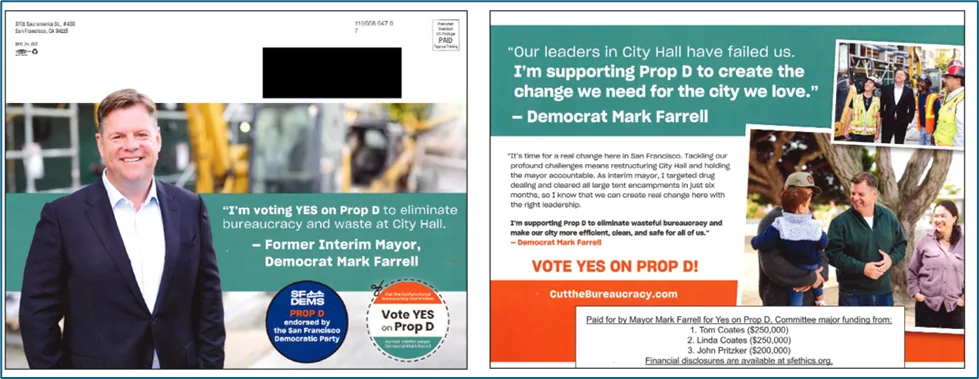
The above ballot measure committee mailer in Exhibit 1 dedicates a significant amount of space to showcasing the controlling candidate, the candidate’s party affiliation, policy positions, and previous officeholder experience and accomplishments.[23] Almost no arguments favoring the proposed ballot measure are discussed, despite this advertisement nominally being a communication in favor of the measure, not the candidate.
Exhibit 2: Images from Mayor Breed’s Committee for Reproductive Freedom, Yes on O (Digital Ads)
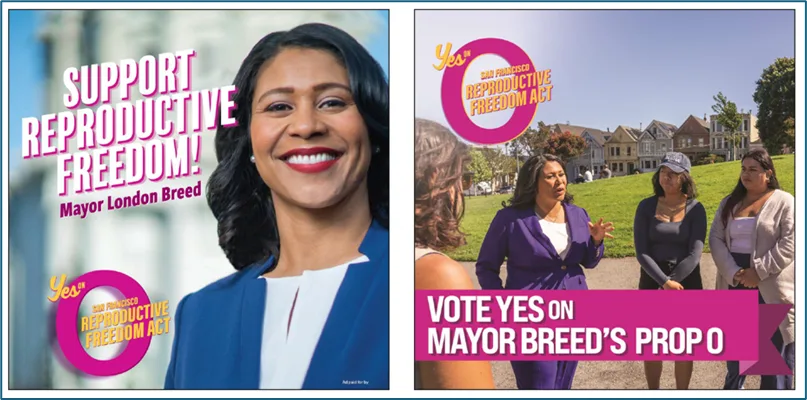
The above ballot measure committee digital ads in Exhibit 2 feature the controlling candidate more than the ballot measure.[24] This may partially be a byproduct of this medium of communication, which is limited by size and space constraints. However, this still provides an example of a candidate’s name and face being shared in a positive manner with the public during the same time period when they are running for City elective office and seeking additional contact with voters. In this particular case, reproductive health was considered a major campaign issue in 2024 when the ad was distributed, and the ad associates the candidate positively with this issue in a clear effort to promote the candidate voters.
Exhibit 3: Images from Mayor Breed’s Committee for Reproductive Freedom, Yes on O (Walk Cards)
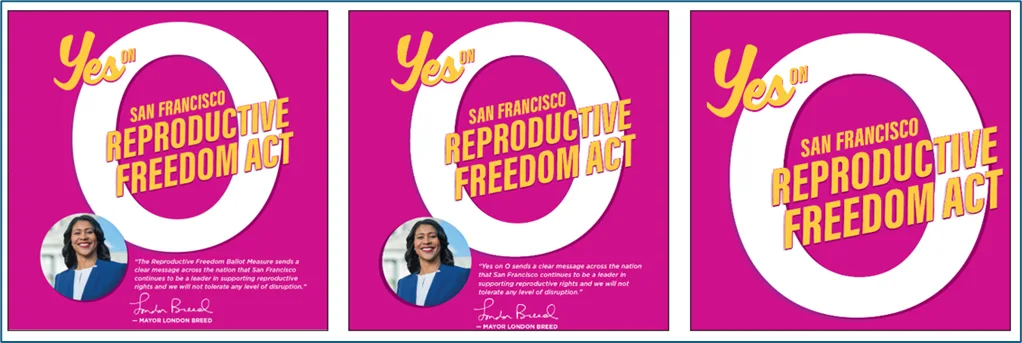
The walk cards in Exhibit 3 are from the same ballot measure committee above and showcase a different ballot measure communication medium, which features the candidate less heavily or not at all.[25] However, even when less heavily featured, the two ads on the left still include the candidate’s photo and rely heavily on quotes from the candidate to convey their message.
The materials in the exhibits above are distinct from ballot measure communications that are not controlled by the candidate, which otherwise may choose to feature quotes or endorsements from a candidate. The distinction lies in the control of the committee. In the examples above, the candidate is able to control the spending and may harmonize it with the activity of their candidate committee in a way that gives their candidacy additional benefits, without regard to contribution limits. This is not a concern if the ballot measure committee is controlled independently from the candiate.
The recent trend of candidates controlling committees, particularly ballot measure committees, that are not subject to the City’s candidate contribution limit creates opportunities for abuse of the current rules. While not entirely comparable, since there are no federal ballot measures, federal law does suggest a potential approach to addressing this situation. Federal Regulation § 300.61 states that no federal candidates, federal officeholders, agents acting on their behalf, or their controlled entities “shall solicit, receive, direct, transfer, spend, or disburse funds in connection with an election for Federal office…unless the amounts consist of Federal funds that are subject to the limitations, prohibitions, and reporting requirements of the Act.” This provision essentially provides that candidates are permitted to control multiple committees, but those other committees are then subject to the same contribution limit as their main candidate campaign committee.[26]
Recommendation
When candidates control committees that are not subject to the City’s candidate contribution limit while simultaneously running for City elective office, the contribution limit is severely undermined, giving rise to the potential for quid pro quo corruption, undue influence, or the appearance thereof.
To address this, the Commission should extend the City’s candidate contribution limit to any other committees a candidate controls while actively running for City office, to the extent possible by law.
Enacting this recommendation would require amending Section 1.114(a) of the Campaign and Governmental Conduct Code (C&GCC). Draft legislative language is provided in Attachment 1 and below. The current $500 candidate contribution limit is contained in subsection 1.114(a), and the new rule would be added to that subsection as 1.114(a)(2-4):
(2) In addition to the limit in subsection (a)(1), no person other than the candidate shall make, and no candidate for City elective office or candidate-controlled committee controlled by such a candidate shall solicit or accept, any contribution which will cause the total amount contributed to that committee by such person to exceed the limit in subsection (a)(1) per election cycle. The contribution limit in this subsection (a)(2) shall not apply to:
- A committee primarily formed to support the candidate in seeking election to a county central committee of a qualified political party; or
- A committee primarily formed to oppose a recall measure in which the candidate is the subject of the recall.
(3) Notwithstanding the limitation in subsection (a)(2) the contribution limit for candidate-controlled legal defense funds shall be $10,000 per election cycle and may be amended through Ethics Commission Regulation.
(4) The limitations in subsections (a)(2) and (a)(3) only apply to candidates who are actively running for City elective office as defined by Ethics Commission Regulation.
For all candidates actively seeking City elective office, their controlled committees would be subject to the $500 contribution limit. However, the draft language reflects the need for certain limitations and exceptions, including:
Exception for candidate committees for county central committee: Candidate committees formed to support a candidate’s election to a CCC would not be subject to these contribution limitations, as state law explicitly states that “a local jurisdiction shall not impose any contribution limitations or prohibitions on an elected member of, or a candidate for election to, a county central committee of a qualified political party….”[27] This prevents local jurisdictions from imposing contribution limits on these committees.
Exception for a candidate’s recall committee: Candidate-controlled ballot measure committees would be exempt when they are formed by an officeholder who is the subject of a recall. This is necessary as recalls are put before voters as ballot measures and it is important to allow officeholders to raise and spend money to defend themselves against efforts to recall them from office. Supporters of a recall effort are allowed to accept unlimited contributions because the recall is a ballot measure. To apply a contribution limit to incumbents defending themselves against a recall while applying no limit to those supporting the recall would not be appropriate.
Higher limit for legal defense funds: Legal defense funds would have an adjusted contribution limit of $10,000. This amount is appropriate given the limited scope of expenditures these committees may make, the high costs associated with legal disputes, and the recommendation later in this report that committee funds may not be used to pay penalties related to ethics and campaign finance violations. This is also in keeping with state guidance that the amounts raised by these committees must be reasonably necessary to cover attorney’s fees and other legal costs related to the proceeding for which the fund is created.[28] This higher limit recognizes the need for candidates and officeholders to potentially use LDFs to help defray legal costs, particularly candidates who may otherwise be under-resourced, while also creating a check against the corrupting influence of unlimited contributions.
Limited only to candidates “actively running” for City elective office: The expanded contribution limit would only apply when the candidate is “actively running” for the City elective office, which is defined through draft Regulation 1.114-3, which is provided in Attachment 2. This serves to narrow the new rule, so that it only applies to officeholders when they are actively seeking reelection, but not before. This means officeholders who are not currently running for re-election would still be able to control ballot measure committees, up to the point they begin running. An officeholder who is not currently running in an election is less incentivized to misuse a ballot measure committee to benefit themselves. And thus, there is less danger of corrupting influence from a controlled committee that can accept unlimited contributions. And, in the research above, most of the candidate-controlled ballot measure committees have been observed when the candidate was also currently running for office. So, the recommended rule is tailored to the issue that has been most prevalent and problematic. A future project could explore whether it is appropriate to also apply limits to committees controlled by officeholders who are not actively running for office.
The proposed expansion of the City’s contribution limit is intended to ensure that well-resourced interests cannot gain favor with candidates or officeholders by making unlimited contributions to their other committees, which could then be spent in ways that undermine the City’s contribution limits. At the same time, the proposal balances the political speech rights of the candidates and officeholders.
The current boundaries of campaign finance law established across the federal, state, and local levels are ultimately defined by the Supreme Court of the United States through analysis based in free speech protections guaranteed under the First Amendment. The constitutional review balances the government’s compelling interest in preventing corruption with the right to freedom of expression, in this case, political speech. Rulings from the Supreme Court set the basis that spending money to influence elections is a form of political speech because “virtually every means of communicating ideas in today’s mass society require the expenditure of money.”[29] Those expenditures are therefore protected under the First Amendment, and any attempts to restrict this speech must serve a compelling government interest. The prevention of quid pro quo corruption—campaign contributors receiving preferential treatment in return for their financial offerings—or the appearance of corruption, has been the only interest deemed necessary by the Court.[30] Later precedent also expanded the definition of corruption beyond quid pro quo to include “the broader threat from politicians too compliant with the wishes of large contributors.”[31]
The Supreme Court has recognized that large contributions to candidates and officeholders raise the problem of corruption, and that given there is sufficient government interest in preventing corruption and the appearance of corruption, it is reasonable to conclude that contribution limits to candidates and officeholders are justified.[32]
The Court has held that direct contributions to candidates and their campaigns hold a greater risk of corruption compared to other forms of paid political speech, thus allowing them to be subjected to regulatory limits. These limits are codified as maximum dollar amounts that contributors can give to a single candidate on a time-bound basis, such as the City’s existing $500 candidate contribution limit. This is also the legal basis reflected in Federal Regulation § 300.61, which applies contribution limits to all committees controlled by a candidate.
There is additional Supreme Court precedent that has struck down certain types of contribution limits, such as contribution limits to campaigns supporting or opposing ballot measures, because although a compelling government interest exists in “regulating and limiting contributions to or expenditures of a candidate…there is no significant state or public interest in curtailing debate and discussion of a ballot measure.”[33] However, the question of imposing a contribution limit that specifically applies only to ballot measure committees that are candidate-controlled has not been directly addressed by the Court.
It is also important that any contribution limitations are put forth using the least restrictive means to achieve its goal in advancing the government’s interest of combatting corruption. With the included exemptions described above, the proposed expansion of the City’s contribution limit is not broader than necessary and, in fact, mirrors the existing federal soft money rule.[34]
Furthermore, it is important to consider the differences between candidate campaign committees and other candidate-controlled committees. Under the current legal framework, the rationale is that, absent a candidate to potentially corrupt, there is no basis for contribution limits. However, with candidate-controlled committees, there is a candidate directly involved with the committee who is clearly identified as controlling the committee. Because of this, a large contribution to a candidate-controlled ballot measure committee may provide, or may give the appearance of providing, outsized benefit to the candidate controlling the committee, creating the potential for corruption and undue influence and ultimately justifying a contribution limit.
Expanding the contribution limit to cover other types of candidate-controlled committees when the candidate is actively running for City elective office still leaves numerous opportunities for the candidate to publicly support or oppose ballot measures. This would not be a prohibition—such candidates could still form and control a ballot measure committee: that committee would just be subject to the same contribution limit as the candidate’s candidate committee. Furthermore, candidates could still donate their personal funds to support or oppose ballot measures, endorse ballot measure campaigns, and speak publicly in favor of such efforts. The proposal would only affect instances in which the candidate opted to directly control a committee that is raising and spending money on a ballot measure campaign.
Considering the recent prevalence of candidates for City elective office simultaneously controlling ballot measure committees, it is important for the City to act quickly before this becomes the new normal in San Francsico elections. It is not difficult to imagine a situation in which more candidates feel the need to control ballot measure committees in the future, in addition to their main campaign committees. For example, if all of a candidate’s opponents are also controlling an additional committee, which can raise unlimited amounts from wealthy contributors that can then be spent on communications that heavily feature the candidate and their policy positions, it could be seen as a competitive necessity to do the same. This effect may also tend to favor incumbent mayors and supervisors since under San Francisco law those officials have the power to place measures on the ballot.
Imposing a contribution limit on committees controlled by candidates who are actively running for City elective office is an important safeguard the City can enact to prevent corruption and reinforce the City’s existing contribution limit.
2. Republication of Campaign Materials
Under current law, unlimited amounts of money can be raised and spent to support or oppose candidates for City elective office, provided that the spending is not coordinated with the candidate. These are known as independent expenditures. However, if the spending is coordinated with the candidate, it is considered a contribution to the candidate and is thus subject to the City’s $500 candidate contribution limit.[35] City law defines when such expenditures are considered independent and when they are coordinated. The law also provides several rebuttable presumptions of coordination and exceptions.[36]
The law states that spending on a communication that expressly advocates for the nomination, election, or defeat of a candidate, is coordinated if it is:
- “…made at the request, suggestion, or direction of, or in cooperation, consultation, concert or coordination with, the candidate on whose behalf, or for whose benefit, the expenditure is made; or”
- “…created, produced or disseminated…[a]fter the candidate has made or participated in making any decision regarding the content, timing, location, mode, intended audience, volume of distribution, or frequency of placement of the communication.”[37]
Essentially, coordination occurs when the candidate, or their agent, communicates with the spender about the communication benefiting their candidacy.
The different types of spending can be illustrated by considering the production and dissemination of lawn signs that clearly support a candidate for City elective office.
Candidate Spending: If a candidate’s own campaign produces and pays for the dissemination of the signs, this spending by the candidate’s campaign will be funded by the candidate’s own committee. The candidate’s committee funds were obtained through contributions that were subject to the City’s $500 candidate contribution limit when the candidate received them.
Independent Expenditures: On the other hand, if a third-party spender produces their own signs that communicate support of the candidate, without coordinating with the candidate, this is an independent expenditure. Because third-party groups are not subject to contribution limits, independent expenditures are funded by contributions that are not subject to the $500 contribution limit, nor is the spending itself considered a contribution to the candidate, which would be subject to the contribution limit.
Coordinated Third Party Spending: However, if the third-party spender were to communicate with the candidate’s campaign about the third party’s production or dissemination of the lawn signs, this would make the expenditure coordinated. If coordinated, the expenditure would constitute an in-kind contribution to the candidate’s committee, since the third party would be providing free or discounted goods or services to the candidate. The third-party spender would therefore be prohibited from spending more than $500 on the signs, as spending more than $500 would violate the City’s candidate contribution limit.
Coordination rules are a vital element of any candidate contribution limit. If candidates could coordinate with “independent expenditure” committees, the candidates would be able to effectively bypass the contribution limit. The third-party committees would nominally be controlled by third parties but would be allowed to work in conjunction with a candidate. This would result in the independent expenditure committee not being truly independent, and the unlimited contributions given to such committees would directly benefit the candidates that are coordinating with them. This would implicate the same dangers of corruption and undue influence that contribution limits exist to prevent. In Buckley, the Court pointed to the independence of third party spending as the core reason why contribution limits cannot be applied to such committees, stating: “[t]he absence of prearrangement and coordination of an expenditure with the candidate or his agent not only undermines the value of the expenditure to the candidate, but also alleviates the danger that expenditures will be given as a quid pro quo for improper commitments from the candidate.”[38] Coordination rules are the legal mechanisms that ensure that independent expenditures are in fact independent from candidates.
Findings
There is a gap in the City’s current coordination rules that allows third-party spenders to pay for the dissemination, distribution, reproduction, or republication of candidate campaign materials, conferring a direct benefit to candidates, while avoiding the City’s candidate contribution limit. This shortcoming in the law allows a third-party spender to take publicly available materials from a candidate’s campaign and then spend unlimited sums to republish them, so long as they do not directly coordinate with the candidate.
Current Coordination Rules Apply Too Narrowly to the Reuse of Candidate Materials
Under current City law, if a third party “replicates, reproduces, republishes or disseminates, in whole or in substantial part, a communication designed, produced, paid for or distributed by the candidate,” that expenditure is presumed to not be independent of the candidate.[39] Unless this presumption is rebutted, this would mean that the expenditure would constitute an in-kind contribution to the candidate. No evidence of direct communication between the candidate and the third party is needed to trigger the presumption: mere replication of a substantial part of a candidate communication is enough to shift the burden to the third party to indicate that no coordination took place. This presumption exists because republication of candidate material would confer a direct benefit to the candidate and would increase the likelihood that the candidate and third party coordinated in some fashion.
The law does not explicitly state the basis for rebutting this presumption of coordination. However, it is possible that under existing law if a third party were to demonstrate that the candidate communication had been publicly available prior to the third party reusing substantial parts of the communication, this would be enough to rebut the presumption. This is because public availability of the communication would indicate a means by which the third party obtained the communication without communicating with the candidate’s committee. By making republication of candidate materials only a presumption that direct coordination communication between the third party and the candidate took place, the law is too narrow to address the problem of third parties directly aiding candidates by republishing their content. This type of activity has been observed in many instances, and the law appears inadequate to address it.
The Nature of Reusing Candidate Campaign Materials
As discussed, current law already addresses instances in which a third party reuses a candidate’s campaign materials as the result of direct coordination with the candidate. It also addresses instances in which a third party reuses such materials and cannot demonstrate that direct coordination did not take place, for example by showing that the materials were publicly available prior to the third party using them. However, the law does not adequately address situations in which candidate campaign materials were republished after being made publicly available. A primary way candidate campaign materials are made available to the public is when the candidate pays to distribute those materials in the form of paid advertisements. When a candidate pays to send direct mail, run television ads, or place digital ads online, they are making their content publicly available. Third parties might observe this content and decide to reuse it, spending their own funds to amplify the candidate’s message using the candidate’s own content.
However, paid advertisements are not the only way in which candidates make their campaign materials publicly available. Candidates often make campaign materials available on their website for anyone to access and download. Such candidate campaign materials can be provided to the public for legitimate purposes, where the campaign is seeking to engage with voters. For example, keeping with the lawn sign example, a campaign may provide a digital copy of its lawn sign on its campaign website, so that voters can access it for personal use. If an individual were to use that file to do “a small-scale printing…solely for the individual’s personal use” it would not be considered a contribution to the campaign or an independent expenditure.[40] For example, the individual could print one of the signs and display it at their home.
Problematically, candidate campaigns often make campaign materials available, not for use by voters, but so that third-party spenders can pay to reuse the materials in paid advertisements. When a campaign puts out materials and strategic guidance through public channels—such as a public facing website—so that third-party spenders can use the materials and information when making unlimited expenditures, this practice is known as “redboxing.” Redboxing is a growing concern across the country because it allows candidates to passively communicate with independent expenditure committees to aid those committees’ efforts to support the candidates in the most effective ways.[41]
Regardless of why or how the campaign materials were made accessible—whether through traditional paid advertising by the candidate’s campaign or by making materials available on a public facing website in a possible attempt to redbox—third-party spending that disseminates, distributes, reproduces, or republishes candidate campaign materials to further the reach of a candidate’s campaign that is not subject to the City’s contribution limit undermines the limit by allowing third parties to pay unlimited amounts to further spread the campaign’s message.
To further demonstrate this regulatory gap, Table 2 describes different spending situations using the lawn sign example and when contribution limits currently apply in those situations.
Table 2: Illustration of When Certain Spending on Lawn Signs is a Contribution and Thus Subject to the Candidate Contribution Limit
| Spending | Is This a Contribution to the Candidate’s Campaign and Subject to the Candidate Contribution Limit? |
| A candidate’s campaign raises and spends money on lawn signs promoting the candidate. | Yes, this is a direct expenditure from the candidate’s campaign, made using contributions raised subject to the contribution limit. No person other than the candidate may contribute more than $500 to the candidate’s committee for this spending. |
| A third-party spender designs, prints, and distributes their own lawn sign, which expresses their support for the candidate. | No, contribution limits do not apply because no contribution is being made to the candidate. This would be an independent expenditure made by the third-party spender and the spender is able to raise and spend unlimited amounts for such activity. |
| A third-party spender coordinates with a candidate’s campaign regarding the spending on the lawn signs. | Yes, this would be considered a contribution, and the contribution limit would apply. Since this spending is coordinated with the campaign, it would be considered a contribution to the campaign, and the spender would only be able to spend up to $500 on the lawn signs. |
| A third-party spender does not directly coordinate with the candidate’s campaign, but does spend money to disseminate, distribute, reproduce, or republish the candidate campaign’s lawn sign. | No, this would not currently be considered a contribution and thus the contribution limit would not apply. Despite the third-party spender paying to disseminate the campaign’s materials, absent proof of direct coordination the presumption of coordination could likely be rebutted, and this spending would not be limited by the contribution limit. |
Of the spending described in the table above, there are two situations where contribution limits do not apply. In the second row, the spending described constitutes independent spending by the third-party, which is protected speech where the spender is paying to make their own independent communications, which cannot be restricted through contribution limits. In the last row, the spender is paying to disseminate the campaign’s materials, furthering the candidate’s speech, yet they are still able to avoid the contribution limit due to this shortcoming in the current law.
Examples of Third-Party Spenders Republishing Candidate Campaign Materials
The following provides examples of instances where third-party spenders appear to be clearly taking a candidate’s campaign materials and then disseminating, distributing, reproducing, or republishing those materials. These examples are not provided to allege wrongdoing by either the candidates or third-party spenders but are used to illustrate the type of conduct that should be squarely prohibited under City law.
San Francisco Working Families and Aaron Peskin’s 2024 Mayoral Campaign
In 2024, Aaron Peskin’s mayoral campaign website contained a “media gallery” page, which provided photos of the candidate and his supporters, as well as three videos. Of the three downloadable videos on the campaign site, two were video advertisements from the campaign, and the third was a series of video clips edited together without audio entitled “Video B-Roll.”[42] The b-roll video featured clips of the candidate throughout the City, often speaking with other people, as well clips of supporters holding campaign lawn signs. Examples of the b-roll video are provided below as Exhibit 4 and in Attachment 5.
Exhibit 4: Images from Peskin Campaign Video B-Roll

During the 2024 election, the “San Francisco Working Families Voter Guide Supporting Aaron Peskin for Mayor, Sponsored by Healthcare, Hospitality, and Service Workers Unions” (hereinafter “SF Working Families”) committee spent $558,355 on independent expenditures supporting Peskin’s 2024 candidacy for mayor.[43] Part of this spending included thousands of dollars spent on the production and dissemination of video ads that heavily utilized the video clips provided in the candidate’s b-roll video. Examples of the SF Working Families advertisements are provided below as Exhibit 5 and in Attachment 5.
Exhibit 5: Images from SF Working Families Advertisements

As illustrated above, the SF Working Families committee appears to have used the candidate campaign’s video content, which the candidate’s campaign had made available to the public through its campaign website. The SF Working Families committee then spent thousands of dollars on advertisements disseminating the campaign’s content. The campaign content featured the candidate, as well supporters holding the campaign’s lawn sign. If it was found that the candidate’s campaign had directly coordinated this spending with SF Working Families, such spending would constitute an in-kind contribution to the candidate’s committee and would also violate the City’s $500 contribution limit. However, absent such direct coordination, the conduct described above would only trigger the rebuttable presumption of coordination under current City law based on the republication of candidate campaign materials. Since those materials were publicly available on the candidate’s website, it is possible that the spender could use that to rebut the presumption and avoid having its spending on the advertisements count as in-kind contributions to the candidate.
Grow SF and Joel Engardio’s 2022 Supervisorial Campaign
In 2022, Joel Engardio was a candidate for the Board of Supervisors. During the election cycle, on October 12, 2022, Engardio’s campaign posted a video to YouTube which began with the candidate introducing himself in Mandarin.[44] Six days later, the “Coalition to Grow San Francsico – Grow SF PAC (hereinafter “Grow SF”),” reporting spending more than $25,000 on a television ad supporting Engardio’s election to the Board of Supervisors.[45] The television ad from Grow SF used the same introduction of the candidate speaking Mandarin as the ad shared by the candidate’s campaign.
Screenshots from both the candidate campaign’s video and the Grow SF advertisement provided below as Exhibit 6 and in Attachment 5.
Exhibit 6: Images from Engardio Campaign Video (left) and Grow SF Video (right).
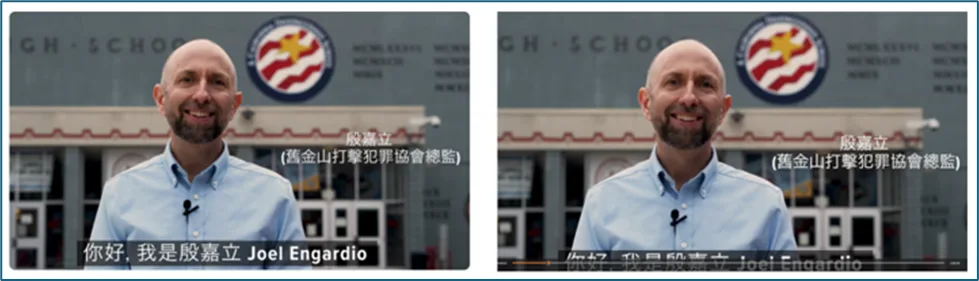
Both videos referenced above are approximately 30 seconds long and are largely distinct aside from the introduction by the candidate. Despite the uniqueness of the remainder of the Grow SF advertisement, having the video begin with a direct-to-camera message from the candidate, which the candidate had recently used in their campaign materials, is an example of a third-party spender disseminating the campaign’s materials. Such dissemination can inflate the reach of the candidate’s campaign materials, while not being limited by City’s contribution limit.
Asian American Freedom PAC and Ellen Lee Zhou’s 2019 Mayoral Campaign
Ellen Lee Zhou was a candidate for mayor in 2019. During the campaign, Zhou’s campaign produced and distributed several comic book-style images, many of which featured the candidate depicted as a superhero. These images were often shared electronically by the candidate and her campaign online as standalone images. The images include disclaimers that clearly identify the images as being paid for by Ellen Lee Zhou for Mayor 2019. Examples of these images are provided below as Exhibit 7 and in Attachment 5.
Exhibit 7: Ellen Lee Zhou for Mayor 2019 Campaign Images

During the 2019 campaign, the “Asian American Freedom Political Action Committee (hereinafter “Asian American Freedom PAC”)” spent $10,000 supporting Zhao’s mayoral bid. Part of this spending included the deployment of billboard advertisements that utilized the same comic book-style images that Zhao’s campaign used. The images used in these billboards were nearly identical to those used by Zhou’s campaign, aside from small modifications and updated disclaimers that indicated the billboards were paid for by Asian American Freedom PAC. An example of one of these billboards is provided below as Exhibit 8 and additional examples are included in Attachment 5.
Exhibit 8: Billboard Paid for by Asian American Freedom PAC

The spending by Asian American Freedom PAC on these pro-Zhou billboards was the subject of an Ethics Commission enforcement matter, where the Commission found that the spending was directly coordinated with the Zhou campaign through its campaign manager and thus constituted an over-the-limit in-kind contribution to Zhou’s campaign.[46] As part of this enforcement matter, the Commission found “[t]he billboards that Asian American Freedom PAC funded contained artwork substantially identical to the artwork in the campaign advertisements previously distributed by the Zhou Campaign Committee…”.[47]
Because direct coordination was proven, the conduct was penalized. Asian American Freedom PAC’s republication of the candidate’s campaign materials helped to prove this direct coordination. However, this example also illustrates the limitations of the current rules. If direct coordination with Zhou’s campaign had not been proven, it would have been possible for the parties to claim that the advertisements had been publicly available to Asian American Freedom PAC after Zhou’s campaign had distributed them. Thus, the rebuttable presumption of coordination that was triggered by the republication of the ads could potentially have been overcome, allowing Asian American Freedom PAC to spend an unlimited amount of money to spread the candidate’s campaign materials without those expenditures counting as contributions to the candidate. In other words, republication of the materials alone was not sufficient to establish that Asian American Freedom PAC had made a contribution to the Zhou campaign.
The above examples are likely a small sample of instances where third parties have spent money to disseminate, distribute, reproduce, or republish candidate campaign materials. Finding additional examples is likely possible but would require additional staff time. Historical examples also get more difficult to find over time, as campaign websites and materials are often taken down quickly after elections.
The types of reproduction described in the examples above identify a path third-party spenders can currently use to contribute to a candidate’s campaign by paying to expand the reach of the campaign’s materials, while avoiding the City’s contribution limits.
Approaches in Other Jurisdictions to Address the Republication of Campaign Materials
Other jurisdictions have rules in place which specify that the republication of a candidate’s campaign materials shall be treated as a contribution to that campaign, which is thus subject to any applicable contribution limits in that jurisdiction.
Federal: Under federal law, expenditures to disseminate campaign materials prepared by a candidate or their campaign are considered contributions to the candidate for the purposes of the applicable contribution limits. The federal rule states that:
“The financing of the dissemination, distribution, or republication, in whole or in part, of any broadcast or any written, graphic, or other form of campaign materials prepared by the candidate…shall be considered a contribution for the purposes of contribution limitations and reporting responsibilities of the person making the expenditure. The candidate who prepared the campaign material does not receive or accept an in-kind contribution, and is not required to report an expenditure, unless the dissemination, distribution, or republication of campaign materials is a coordinated communication [as defined under federal law].”[48]
The federal law specifies that such contributions do not need to be reported as received by the candidate campaign whose materials were republished unless direct coordination occurred.
Philadelphia: For more than a decade, the City of Philadelphia has had a rule specifying that the republication of campaign communications or materials is considered a contribution to the candidate for the purpose of contribution limits. This rule specifies that—for the purpose of Philadelphia’s candidate contribution limit—spending “… to reproduce republish, or disseminate a campaign communication (including audio recordings or video footage) or campaign material (such as photographs, flyers, signs, or brochures) prepared by a campaign…[s]hall be considered an in-kind contribution made by the spender.”[49] As with federal law, the Philadelphia rule similarly creates a distinction between a contribution being made by the spender and a contribution being received by the candidate’s campaign. Only when direct coordination occurs is the contribution considered received by the candidate, who would then need to report the contribution and could then be held liable for violating the contribution limit. But, regardless of whether direct coordination occurred, the spender is still treated as having contributed to the candidate’s campaign and is thus subject to Philadelphia’s candidate contribution limits. When considering the creation of this rule in 2014, the Philadelphia Board of Ethics found that the rule was “…necessary to prevent circumvention of the contribution limits.”[50]
Los Angeles: The City of Los Angeles has a rule specifying that the reproduction of campaign materials constitutes an in-kind contribution to the candidate whose materials are being reproduced. The rule states that anyone “…who reproduces, broadcasts, or distributes in whole or substantial part any material that is drafted, printed, prepared, or previously broadcast or distributed by a candidate or a committee has made a nonmonetary contribution to the candidate or committee.”[51] This rule is unique from the prior examples in that it requires the spender to notify the candidate’s campaign of the reproduction, presumably so that the campaign can then report the contribution as received. However, the rule also specifies that the candidate’s campaign shall “…not be liable for any violations resulting from the reproduction if it provides sufficient evidence to show that it had no prior knowledge of the reproduction.”[52] The Los Angeles City Ethics Commission issued penalties for a violation of this rule in 2015, when it found that a third party spent money in excess of the contribution limit to reproduce and distribute a “…two-page mailer…[that was] almost identical to a mailer previously created and distributed by the candidate committee…”.[53] The Los Angeles Ethics Commission did not need to prove direct coordination between the candidate and the third-party spender in order to hold the third-party spender liable for spending money to republish the candidate’s mailer; the republication alone was sufficient to establish that an in-kind contribution to the candidate had been made.
The preceding examples provide similar, yet distinct approaches for the Commission to consider and borrow from when considering the creation of a republication rule for San Francisco.
Recommendation
When third parties spend money to republish a candidate’s campaign materials, they are directly providing a benefit to the campaign that should be treated as a contribution made to the candidate for the purpose of the City’s candidate contribution limit. Allowing third-party spenders to spend unlimited amounts on the reproduction of campaign materials undermines the City’s contribution limits and rules against coordination with third party spenders.
The republication of candidate campaign materials allows third party spenders to align their messaging, branding, logos, and other content seamlessly with candidates largely without running afoul of rules against coordination. In Buckley, the Court clearly intended that independent expenditures would be distinct from candidate campaign activities. When “independent” expenditures merely reproduce candidate communications, they become indistinguishable from the candidate’s own campaign activities. This creates an inappropriate channel for third-party spenders, which under the First Amendment cannot be subjected to contribution limits themselves because of their independent nature, to spend significant sums to directly amplify and republish a candidate’s campaign content.
To address this,the Commission should adopt a republication rule that clarifies that expenditures to republish a candidate’s campaign materials are contributions to the candidate for the purpose of the City’s candidate contribution limit.
Draft language for this rule is included in Attachment 1, and draft supporting regulations are included in Attachment 2. The draft legislative language creating this rule, which would be added to Section 1.115 of the Campaign and Governmental Conduct Code, is also provided below:
(d) Dissemination, distribution, reproduction, or republication of candidate campaign materials. Notwithstanding subsections (a-c), for the purposes of the contribution limit in subsection 1.114(a), an expenditure shall be treated as a contribution from the person making the expenditure to the candidate for whose benefit the expenditure is made, if the expenditure funds a communication that disseminates, distributes, reproduces, or republishes, in whole or in part, any written, graphic, audio, audiovisual, or any other form of campaign material prepared, produced, disseminated, distributed, or published by the candidate, the candidate’s candidate committee, or agents thereof. However, such a contribution is not received or accepted by the candidate, and is not required to be reported by the candidate, unless the spending is coordinated as defined in subsections (a-c). The Ethics Commission may exempt the use of certain campaign materials from being considered a contribution under subsection (d) by regulation.
As with the rules from other jurisdictions presented above, this proposed rule creates liability for the spender, not the candidate. A spender would be in violation of the law if they spent more than $500 to republish a candidate’s campaign material. The republication alone would not necessarily create liability for the candidate. However, current law would still apply such that the spending could also result in violations by the candidate for accepting contributions in excess of the $500 limit if (a) the candidate is unable to overcome the rebuttable presumption of coordination based on republication of campaign materials, or (b) the candidate is found to have directly coordinated with the spender.
To implement this proposed rule, the Commission should adopt the draft regulations in Attachment 2 to clarify terms and create limited exceptions. The following briefly summarizes the draft regulations.
Regulation 1.115-1: Defines when a communication is “disseminated, distributed, reproduced, or republished.” Further defines “reproduction” and provides factors the Commission could use to determine when reproduction has occurred. The inclusion of reproduction is important to capturing instances where a third-party spender may seek to replicate a candidate’s campaign materials, to the point where a reasonable person would perceive them as being from the candidate’s campaign.
Regulation 1.115-2: Establishes limited exceptions to this rule, which are intended to ensure independent spenders can communicate their views in an election without it necessarily being considered a reproduction of candidate campaign materials. These exceptions are similar to those found in other jurisdictions and carve out the use of brief quotes from the candidate, basic biographical information, and materials that originate from outside of the campaign, but which may also be subsequently used by the candidate’s campaign.
Regulation 1.115-3: Defines when an expenditure is made for the benefit of the candidate. This definition includes expenditures that expressly advocate for the election of a candidate and those which would be perceived as conveying a positive impression of the candidate to the viewer.
It is vital that independent expenditures are truly independent of the candidate’s campaign. Independent spending that expressly advocates for a candidate is different than spending that redistributes a candidate’s campaign materials. If expenditures are made to redistribute a candidate’s campaign materials, those should be treated as contributions to that candidate and be subject to the same limit as other contributions. Allowing third parties to spend unlimited amounts to redistribute candidate campaign materials undermines the City’s contribution limit. Such unlimited spending creates a path for wealthy contributors to inflate the reach of a candidate’s campaign beyond what it could accomplish through contributions received under the City’s contribution limit.
Adopting a strong republication rule as described above would close a significant gap in current law, which allows third-party spenders to directly further the message of a candidate’s campaign while circumventing the City’s candidate contribution limit.
3. Penalties for Elected Officers Paid by Others Through Committees
The Campaign and Governmental Conduct Code is designed to promote integrity and public trust by establishing clear rules and imposing meaningful consequences for violations. Monetary penalties are intended to serve as a deterrent against future misconduct and create accountability for violations of the law.
The San Francisco Charter authorizes the Ethics Commission to impose penalties for violations of the law relating to campaign finance and governmental ethics under the Campaign and Governmental Conduct Code. The Charter allows the Commission to impose fines of up to $5,000 for each violation, or three times the amount that was not properly reported or that was unlawfully contributed, whichever is greater. [54]
In determining the appropriate penalty amount, the Commission considers the degree of public harm, the scope of the violations, and the respondent’s ability to pay, among all other relevant circumstances surrounding the case.[55] Enforcement matters also determine who is liable for each violation based on factors such as who holds legal responsibility under the Code, who exercised control over the activity, and who received any relevant benefits.
There are several mechanisms that limit the extent to which City officials may receive funds from others to cover the cost of Ethics Commission penalties.
Annual Gift Limit: City officers and employees who are required to file the Statement of Economic Interests (Form 700) are subject to the annual gift limit of $630. This limit prohibits the acceptance of gifts from single reportable source that would exceed $630 in a calendar year.[56] This means that a Form 700 filer cannot, for example, accept a large sum of money from an individual to cover the cost of paying Ethics Commission penalties. If the person is a reportable source, such payment would be limited to $630 per year.
Restricted Source Gift Rule: San Francisco prohibits all City officials from accepting gifts from restricted sources, which include people with business before the official or their department.[57] Thus, an official would be prohibited from accepting any money from a restricted source to cover the cost of Ethics penalties (or for any other purpose).
Restrictions on the Use of Committee Funds: Campaign finance laws allow the use of committee funds to pay or reimburse fines, penalties, judgments, or settlements only when the expenditure is directly related to a political, legislative, or governmental purpose.[58] An elected official may use their candidate committee (which is considered an officeholder committee once the candidate assumes elective office) to pay Ethics Commission penalties. However, all contributions to such committees are limited to $500 per person. This limits an elected official’s ability to receive large payments from one individual to pay penalties or other costs.
These provisions strengthen accountability by preventing others from coming in to pay penalties on behalf of a City official, thus helping ensure that penalties carry meaningful consequences.
Despite these provisions, it remains possible for City elective officers to accept payments of any amount to pay penalties through a legal defense fund (LDF). As discussed above, legal defense funds are a type of candidate-controlled committee that candidates and elected officials can establish to pay legal costs such as attorney fees and other legal expenses that arise from “an election campaign, the electoral process, or the performance of the officer’s governmental activities and duties.”[59] The funds are commonly used for attorney fees in cases when there is a ballot qualification dispute, late or inaccurate disclosure filings, or other compliance matters, all of which can be costly. Legal defense funds are not subject to any contribution limits under state or City law. This enables candidates and elected officials to respond to such legal matters without relying on personal or campaign committee funds and is particularly valuable for those who would otherwise be unable to afford adequate representation. Any candidate or elected official can establish an LDF once a legal proceeding is reasonably anticipated or has begun.
The Political Reform Act specifically prohibits the use of LDF funds to pay for “penalties, judgments, or settlements related to a claim of sexual assault, sexual abuse, or sexual harassment filed against the candidate or elective officer in any civil, criminal, or administrative proceeding.”[60]
Findings
The ability of elected officials to pay penalties from LDF or candidate committee funds creates dynamics that can undermine the intended impact of Ethics Commission penalties. This is particularly an issue for City elective officers in the context of ethics-related penalties because it decreases personal accountability and creates opportunities for wealthy interests to curry favor with officials by paying their penalties. Because LDFs have no contribution limits, they present a way to circumvent gift rules.
Examples of Penalties Being Paid with LDF Funds
Although State law restricts certain uses of LDF funds, they may currently be used to pay penalties for violations of ethics and campaign finance laws in San Francisco. This can be seen through the two examples presented below involving legal defense funds established by City elective officers.
Breed Legal Defense Funds (Mayor and Supervisor 2012)
In 2021, the Ethics Commission fined Mayor London Breed $22,792 for violations of campaign finance, ethics, and gift laws. The violations (and penalties) consisted of: accepting political contributions more than legal limit ($4,500), failing to disclose political contributions ($7,500), misusing her City title for personal purposes ($2,500), and accepting a prohibited gift from her former subordinate, Public Works Director Mohammed Nuru ($8,292).[61] Mayor Breed agreed to a stipulated settlement with the Commission.
However, Mayor Breed did not personally pay any of the penalties. Mayor Breed used two LDFs to pay the penalties following the approval of the stipulation.[62] Specifically, $10,792 was paid from “Breed Legal Defense Fund – Mayor” and $12,000 from “Breed Legal Defense Fund – Supervisor 2012.”[63] These two funds together received significant contributions from just two individual contributors covering the full Ethics Commission penalty amount as well as attorney fees. Approximately three weeks after Mayor Breed signed the stipulation, “Breed Legal Defense Fund – Mayor” received $15,000 from Oakland real estate investor Wayne Jordan and $12,242 from Ripple Labs CEO Chris Larsen. On the same day, “Breed Legal Defense Fund – Supervisor 2012” received $30,550 from Larsen.
Peskin Legal Defense Fund
In 2019, the Ethics Commission fined Supervisor Aaron Peskin $8,000 for campaign finance violations arising from his 2015 campaign. The violations involved placing advertisements in Chinese-language newspapers that failed to meet disclaimer requirements, including the use of undersized font and, in some cases, the omission of required information directing readers to the Ethics Commission’s website.[64] Supervisor Peskin initially loaned approximately $27,000 to his legal defense fund to cover legal and compliance expenses associated with the matter, including the penalty.[65] In subsequent years, his LDF raised substantial contributions, totaling $16,250 from October 2021 to March 2022 and another $14,000 in 2023, which were used to repay that loan. These contributions were primarily from committees rather than individuals, with each committee’s contributions ranging from $1,250-$15,000.
Impact of Ethics Penalties Paid Through LDF or Candidate Committee Funds
There is a clear difference between an elected official paying ethics penalties using their own personal funds as opposed to funds in their candidate committee or an LDF, as illustrated in the examples above. Allowing penalties that arise from ethics-related violations to be paid for using committee funds can have the following negative effects:
Diminishes the Impact of Penalties: Allowing elected officials to externalize the financial burden of ethics penalties through contributor support and subsequent fundraising diminishes the impact of penalties and their deterrent effects. In the example above, Mayor London Breed did not ultimately bear the financial burden of her ethics violations for misusing her City title or accepting a gift from her subordinate, even though these were violations that she herself personally carried out. When penalties are financed through third-party contributions or repaid through subsequent fundraising, the intended effect of enforcement is significantly undermined. This mitigation of consequences lessens the penalty’s impact on the elected official, thereby weakening accountability.
Undermines Gift Rules: Raising money through an LDF to pay for ethics penalties that the elected official would otherwise be responsible for paying can allow outside sources to give money that may otherwise have been prohibited under state and City gift rules. City elective officers are all Form 700 filers and are thus prohibited from accepting gifts in excess of the annual gift limit, which is currently $630. However, contributions to committees are not considered gifts, meaning that City elective officers are able to use their LDFs to accept funds beyond the gift limit, and potentially from restricted sources, which can then be used to pay their penalties. Such committee contributions function as a substitute for gifts and confer a concrete and potentially substantial personal benefit to the City elective officer. This creates opportunities for those with business before the officer to contribute to an LDF in hopes of currying favor with the officer, which is exactly what the gift rules seek to prevent.
Inequitable Access to LDFs: There are more than 5,000 city officers and employees who file the Form 700 and are thus prohibited from accepting more than $630 in gifts per year from any reportable sources.[66] However, only City elective officers can establish LDFs and then use LDF funds to pay their ethics penalties. This creates a two-tiered system that gives City elective officers, who have the greatest authority and influence over governmental decisions, an ability to offset their penalty burdens, which is not available to City employees. Not only does this undermine the consistency of the City’s ethics laws, but it also forgoes the principle that elective officers should be held to equal, if not higher, standards of accountability than City employees.
Impact of Campaign Finance Penalties Paid Through LDF or Candidate Committee Funds
The use of LDF or committee funds to pay for campaign finance penalties can carry some of the same negative implications discussed above in the context of ethics violations. It can diminish the candidate’s personal accountability, and insofar as an LDF is used, it can be a channel for unlimited contributions that benefit the elected official. However, in many cases these implications are less severe because of the differences between ethics laws and campaign finance laws.
First, candidates almost always rely on compliance professionals or volunteer staff to carry out much of the compliance work that is required under City and state law. Candidates themselves often do not submit campaign disclosure statements, ensure proper disclaimer placement, or vet individual contributions for compliance with applicable limits such as the contractor contribution rule. Often there is a team of staff or contractors who perform this work. Thus, elected officials do not usually bear the same level of personal culpability in routine campaign finance violations that they do in ethics violation such as a conflict of interest or unlawful gift. In such cases, the use of committee funds to pay penalties does appear appropriate.
Secondly, paying penalties from a candidate committee still presents a meaningful consequence for the candidate because the funds cannot be used on campaign activity or officeholder expenses as the candidate would likely prefer. Also, the official would have had to raise any funds in their candidate committee in amounts of $500 or less because of the City’s candidate contribution limit. So, the funds would be the result of the candidate’s ongoing fundraising work, as opposed to one massive payment from an individual, as in the case of an LDF.
Third, when an elected official, their campaign staff, or compliance professionals violates campaign finance laws, the candidate committee is liable for the violations and is typically named as a respondent. Under City law, whenever a committee is liable for a violation, the controlling candidate or officer and the treasurer are also jointly and severally liable.[67] But the committee itself is also liable, and for that reason committee funds are often used to pay such penalties. In contrast, elected officials are solely liable for ethics-related penalties. There is no provision of law that makes their officeholder committee or any other committee liable for ethics violations, as is the case for campaign finance violations.
The use of committee funds is being identified as a concern in other jurisdictions as well. Advocates in other jurisdictions have raised the use of committee funds as potential means of outsourcing penalties. Most recently, the Los Angeles City Charter Reform Commission approved Charter language granting their Ethics Commission the discretion to prohibit campaign funds to pay off fines.[68] The proposal will be submitted to the City Council for potential placement on the November 2026 ballot.
Recommendations
To ensure that Ethics Commission penalties have their intended effects, the Commission should limit the ability of City elective officers to use candidate committee funds or legal defense funds to pay for ethics and campaign finance violations for which they are found personally liable. The rules should differ between ethics violations and campaign finance violations because of the inherent differences between them discussed above.
For ethics-related penalties, the following rule would be most appropriate:
- Prohibit elected officials from using a legal defense fund, candidate committee, or any other candidate-controlled committee to pay penalty resulting from ethics violations.
- This would apply to Campaign and Governmental Conduct Code Article III, Chapter 2 (conflicts of interest, gifts, incompatible activities, etc.) and Article III, Chapter 6 (behested payments).
- Elected officials would still be permitted to use an LDF to pay for all legal costs associated with an investigation, including attorney fees. Only the ultimate penalty would be prohibited from being paid with committee funds.
The draft legislative language creating this rule, which would be added to Section 3.242 of the C&GCC is provided below and included in Attachment 1.
(e) Prohibition on Using Committee Funds to Pay for Ethics Penalties. City elective officers are prohibited from using funds from any candidate-controlled committee, as defined in Section 1.104, that they control, to pay administrative penalties under subsection (d) for which they are personally liable.
This prohibition would be comparable to the existing the state prohibition on using legal defense funds to pay for penalties, judgments, or settlements arising from claims of sexual assault, abuse, or harassment. In doing so, it would apply the same principle to ethics penalties: that violations of ethics rules should result in consequences for the officeholder and cannot be paid with officeholder committee funds or LDF funds.
Under this proposed change, elected officials could still establish legal defense funds for the purposes of paying for legal costs, such as attorneys’ fees and other legal expenses related to an ethics investigation. This would allow them to respond to such legal matters without relying on personal funds, particularly where they may otherwise be unable to afford adequate representation. Though, as proposed in Section I above, the Commission should consider enacting a $10,000 contribution limit for LDFs. This would address the current situation in which officers who are subject to the $630 gift limit may accept unlimited payments to their LDFs. A $10,000 limit balances the interest in limiting the potential for corruption and undue influence with the ability of officers to meet the costs of legal proceedings.
For campaign finance-related penalties, the following rule would be most appropriate:
- Prohibit elected officials from using a legal defense fund to pay penalties resulting from campaign finance violations.
- This would apply to Campaign and Governmental Conduct Code Article I, Chapter 1.
- Elected officials would still be permitted to use an LDF to pay for all legal costs associated with an investigation, including attorney fees. Only the ultimate penalty would be prohibited from being paid with LDF funds.
- Allow elected officials and candidates to use the funds of a candidate-controlled committee to pay a penalty resulting from a campaign finance violation if (a) the committee in question is also liable for the violation, and (b) the elected official or candidate did not personally violate the law in a knowing or willful manner.
- This would apply to Campaign and Governmental Conduct Code Article I, Chapter 1.
The draft legislative language creating this rule, which would be added to Section 1.170 of the C&GCC is provided below and included in Attachment 1.
(d) LIMITATIONS ON USING COMMITTEE FUNDS TO PAY PENALTIES. Candidates for City elective office and City elective officers are prohibited from using funds from any legal defense fund that they control to pay administrative penalties arising from violations of this Chapter 1 for which they are personally liable. Administrative penalties arising from violations of this Chapter 1 may be paid using funds from other candidate-controlled committees, insofar as such committee is also liable for the violations in question, unless the candidate or City elective officer personally violated the chapter in a knowing or willful manner.
Under this proposed change, elected officials would be prohibited from using an LDF to pay a campaign finance-related penalty. This is the same as the recommendation regarding ethics-related penalties above. However, in recognition of the differences between ethics laws and campaign finance laws, the proposed statute would allow elected officials to use the funds of a candidate committee or other controlled committee to pay campaign finance penalties if the committee is also liable for the violations in question. For example, if a candidate’s campaign accepts prohibited contributions from contractors, the candidate committee is liable for the violation and thus candidate committee funds could be used to pay the penalty.
However, the proposal would disallow the use of committee funds to pay a penalty if the elected official in question personally carried out the violation in a knowing or willful manner. For example, if the elected official knew that a City contractor was prohibited from contributing and the official directed their campaign staff to accept the contribution anyway, that would be a willful violation by the official that could not be paid from committee funds.
For candidates who run for election and lose, they are not subject to gift restrictions, so they can accept gifts of any amount from any person to pay their penalties without violating the law. Thus, the recommendations concerning payment of campaign finance-related penalties are only relevant to sitting elected officials.
The proposed rules regarding both ethics penalties and campaign finance penalties by elected officials appropriately balance a respondent’s ability to meet the costs of an investigation and the need for meaningful consequences that match the type of violation involved. Concerns regarding a respondent’s ability to pay are already addressed through the Commission’s existing enforcement regulations.[69] The Commission has the discretion to reduce fines where a demonstrated inability to pay is established during the enforcement process.[70] When a penalty amount is reduced due to an inability to pay, the Commission identifies the full penalty amount associated with the violation to establish the relevant precedent, while then specifying the reduced amount for which the respondent is ultimately liable. This preserves both accountability and consistency in the process, while allowing for reduced penalties when appropriate due to financial hardship.
The recommendations above advance the purposes of the Code by reinforcing meaningful consequences for violations and ensure that penalties serve as an effective deterrent against misconduct. It would strengthen the integrity of the City’s gift rules by preventing elected officials, who have the greatest authority and influence over government decisions, from avoiding gift rules and shifting the financial consequences of their violations onto other parties.
Next Steps
The Commission should review and provide feedback on the recommendations within this report and the attached draft legislation and corresponding regulations. If the Commission supports moving forward with these recommendations, Staff will work with the City Attorney’s Office to incorporate any necessary changes to the draft legislation and return with legislation for the Commission to consider and potentially vote on during the May meeting.
This legislation would require supermajority approval from both the Ethics Commission and the Board of Supervisors to be enacted.[71] If the Commission does wish to move forward with these recommendations, Staff can begin working to identify potential sponsors at the Board of Supervisors prior to the May meeting.
As this is an election year, any final version of this legislation would have an operative date no sooner than January of 2027. This would allow the Commission sufficient time to prepare or update relevant compliance and training materials, while giving the regulated community time to prepare for these changes.
Attachments:
Attachment 1: Draft Campaign Finance Legislation
Attachment 2: Draft Ethics Commission Regulations
Attachment 3: Data Tables re: Prevalence of Candidate-Controlled Committees
Attachment 4: Examples of Candidate-Controlled Ballot Measure Committee Communications
Attachment 5: Examples of Republication
[1] San Francisco Ethics Commission, Announcement of Interested Persons Meetings to Discuss Potential Changes to City Rules Regarding Campaign Finance and Committee Coordination (Feb. 9, 2026).
[2] Participants included representatives from the regulated community (Neilsen Merksamer LLP, Rutan & Tucker LLP, View Avenue Group LLC), political consulting and compliance firms (Anderson Political, CJ and Associates), peer jurisdictions (New York Campaign Finance Board, San Diego Ethics Commission), individual campaign treasurers, and various good government groups (League of Women Voters of San Francisco, Common Cause California, California Clean Money Campaign).
[3] Staff have met with representatives from the Campaign Legal Center, the Brennan Center, the New York Campaign Finance Board, the Philadelphia Board of Ethics, the Los Angeles Ethics Commission, Neilsen Merksamer LLP, and Common Cause California.
[4] San Francisco Campaign and Governmental Conduct Code, § 1.114.
[5] California Common Cause, California Municipal Campaign Finance Index California Municipal Campaign Finance Index(2025).
[6] Buckley v. Valeo (1976) 424 U.S. 1.
[7] Political Reform Act (Gov. Code, § 82013).
[8] Political Reform Act (Gov. Code, § 82007); San Francisco Campaign and Governmental Conduct Code, § 1.104.
[9] Political Reform Act (Gov. Code, § 85201); San Francisco Campaign and Governmental Conduct Code, § 1.108.
[10] Political Reform Act (Gov. Code, § 82016); San Francisco Campaign and Governmental Conduct Code, § 1.104.
[11] San Francisco Campaign and Governmental Conduct Code, § 1.104.
[12] San Francisco Campaign and Governmental Conduct Code, § 1.114.
[13] Political Reform Act (Gov. Code, § 89510); San Francisco Campaign and Governmental Conduct Code, § 1.108.
[14] Political Reform Act (Gov. Code, § 85703).
[15]Fair Political Practices Commission, Advice Letter A-14-148 (Betty Ann Downing, 2014) (interpreting the Political Reform Act to prohibit candidates from making independent expenditures to support or oppose other candidates).
[16] San Francisco Campaign and Governmental Conduct Code, § 1.122(b)(2).
[17] Political Reform Act (Gov. Code, § 85304.5).
[18] San Francisco DataSF, Campaign Finance Transactions.
[19] In 2020, then-Supervisor Matt Haney controlled a ballot measure committee for the November election as a sitting officeholder, while not simultaneously appearing on the ballot.
[20] San Francisco Ethics Commission, Stipulation, Decision and Order, In the Matter of Mayor Mark Farrell for Yes on Prop D, Mark Farrell for Mayor 2024, Mark Farrell, and Roy Herrera (2024).
[21] Ibid.
[22] San Francisco DataSF, Campaign Finance Transactions.
[23] Fair Political Practices Commission, Form 460 Amendments, Recipient Committee Campaign Statement, Filing ID Nos. 212493587, 212493628 (Nov. 4, 2024).
[24] San Francisco Ethics Commission, Form 162, Electioneering Communication Report, Filing ID Nos. 212469923, 212449501, 212433483, 212425499, 212386295, 212360146, 212313325, 212304860, 212281432, 212268357, 212259101 (Oct. 7, 2024 – Oct. 31, 2024).
[25] Ibid.
[26] 11 C.F.R. § 300.61 (52 U.S.C. § 30125(e)(1)(A)).
[27] Political Reform Act (Gov. Code, § 85703).
[28] Fair Political Practices Commission, State Contribution Limits and Voluntary Expenditure Ceilings: Exceptions.
[29] Buckley v. Valeo (1976) 424 U.S. 1.
[30] Ibid.
[31] Nixon v. Shrink Missouri Government PAC (2000) 528 U.S. 389.
[32] Buckley v. Valeo (1976) 424 U.S. 1, 26–27.
[33] Citizens Against Rent Control v. City of Berkeley (1981) 454 U.S. 290.
[34] 11 C.F.R. § 300.61 (52 U.S.C. § 30125(e)(1)(A)).
[35] San Francisco Campaign and Governmental Conduct Code, § 1.114(a).
[36] San Francisco Campaign and Governmental Conduct Code, § 1.115.
[37] Ibid.
[38] Buckley v. Valeo (1976) 424 U.S. 47.
[39] Ibid. at § 1.115(b)(4).
[40] Fair Political Practices Commission, Advice Letter No. I-24-075 (Aug. 9, 2024).
[41] Campaign Legal Center, Voters Need to Know What “Redboxing” Is and How It Undermines Democracy (March 27, 2025).
[42] Aaron Peskin for Mayor 2024, Gallery.
[43] San Francisco DataSF, Campaign Finance Transactions (entry for “San Francisco Working Families Voter Guide Supporting Aaron Peskin for Mayor, Sponsored by Healthcare, Hospitality, and Service Workers Unions,” ID # 1474947).
[44] Why we support Joel Engardio (Mandarin) (YouTube, uploaded by Engardio, Oct. 12, 2022),
https://www.youtube.com/watch?v=AguthfKcCmQ.
[45] Fair Political Practices Commission, Form 496, Independent Expenditure Report, Filing ID No. 205198148 (Oct. 18, 2024).
[46] San Francisco Ethics Commission, In the Matter of Paul Allen Taylor, Case No. 1920-031, Findings and Order (Mar. 22, 2024).
[47] Ibid.
[49] Philadelphia Board of Ethics, Regulation 1.38.
[50] Philadelphia Department of Records, Board of Ethics Regulations.
[51] Los Angeles Municipal Code, § 49.7.18.
[52] Ibid.
[53] Los Angeles City Ethics Commission, Stipulation and Settlement Agreement, In the Matter of LA Citizens (2015).
[54] San Francisco Charter, § C3.699-13.
[55] San Francisco Ethics Commission, Enforcement Regulation § 9(D)(7).
[56] Political Reform Act (Gov. Code, § 89503).
[57] San Francisco Campaign and Governmental Conduct Code, § 3.216; San Francisco Ethics Commission, Regulation 3.216(b)(1)–(6).
[58] Political Reform Act (Gov. Code, § 89513).
[59] Gov. Code, § 85304; 2 Cal. Code Regs., § 18530.4.
[60] Gov. Code, § 85304; 2 Cal. Code Regs., § 18530.4(d)(1).
[61] San Francisco Ethics Commission, Stipulation, Decision and Order, In the Matter of London Breed (SFEC Complaint No. 1920-072) (Aug. 2, 2021).
[62] Breed Legal Defense Fund – Mayor (ID # 1440413) and Breed Legal Defense Fund – Supervisor 2012 (ID # 1440641).
[63] It appears that the two LDFs were used to separately pay the penalties arising from violations during Bred’s tenure as supervisor (supervisor LDF) and mayor (mayor LDF).
[64] San Francisco Ethics Commission, Stipulation, Decision and Order, In the Matter of Aaron Peskin (SFEC Complaint No. 1516-11).
[65] Peskin Legal Defense Fund (ID # 1422353).
[66] Sources that are reportable vary by positions, which can have different disclosure categories, and City elective officers have the broadest disclosure category.
[67] San Francisco Campaign and Governmental Conduct Code, 1.170(g), (h).
[68] Los Angeles City Charter Reform Commission, Agenda, Special Meeting (Mar. 24, 2026); Los Angeles City Charter Reform Commission, Proposed Charter Language Regarding Administrative Hearings, Orders, and Penalties (Mar. 24, 2026).
[69] San Francisco Ethics Commission, Enforcement Regulation § 9(D)(7).
[70] See, e.g., San Francisco Ethics Commission, Stipulation, Decision and Order, In the Matter of Walter Park (SFEC Complaint No. 24-671, Sept. 27, 2024), p. 10; San Francisco Ethics Commission, Stipulation, Decision and Order, In the Matter of John Avalos (SFEC Complaint No. 13-150618), p. 5, San Francisco Ethics Commission, Stipulation, Decision and Order, In the Matter of Quintin Mecke (SFEC Complaint No. 27-151015, Sept. 21, 2018), p. 4.
[71] The Commission could also place such legislation on the ballot for approval by the voters.